








Chatty and Gorgias agree on one unusual thing. Neither charges you for a seat.
Gorgias says so on its own pricing page: the helpdesk "scales from 50 to 5,000 tickets a month, never priced per agent." Chatty meters AI conversations and leaves human chat unlimited on every plan.
Then they split. Gorgias charges when its AI finishes a conversation, and Chatty charges when a conversation starts. One prices the outcome, the other prices the attempt.
That choice does more than set the size of the invoice. It decides who keeps the value when a conversation goes well.
On Gorgias, a sharper AI closes more conversations on its own, which is the event the invoice counts. On Chatty, a sharper AI sells more, and the meter never notices.
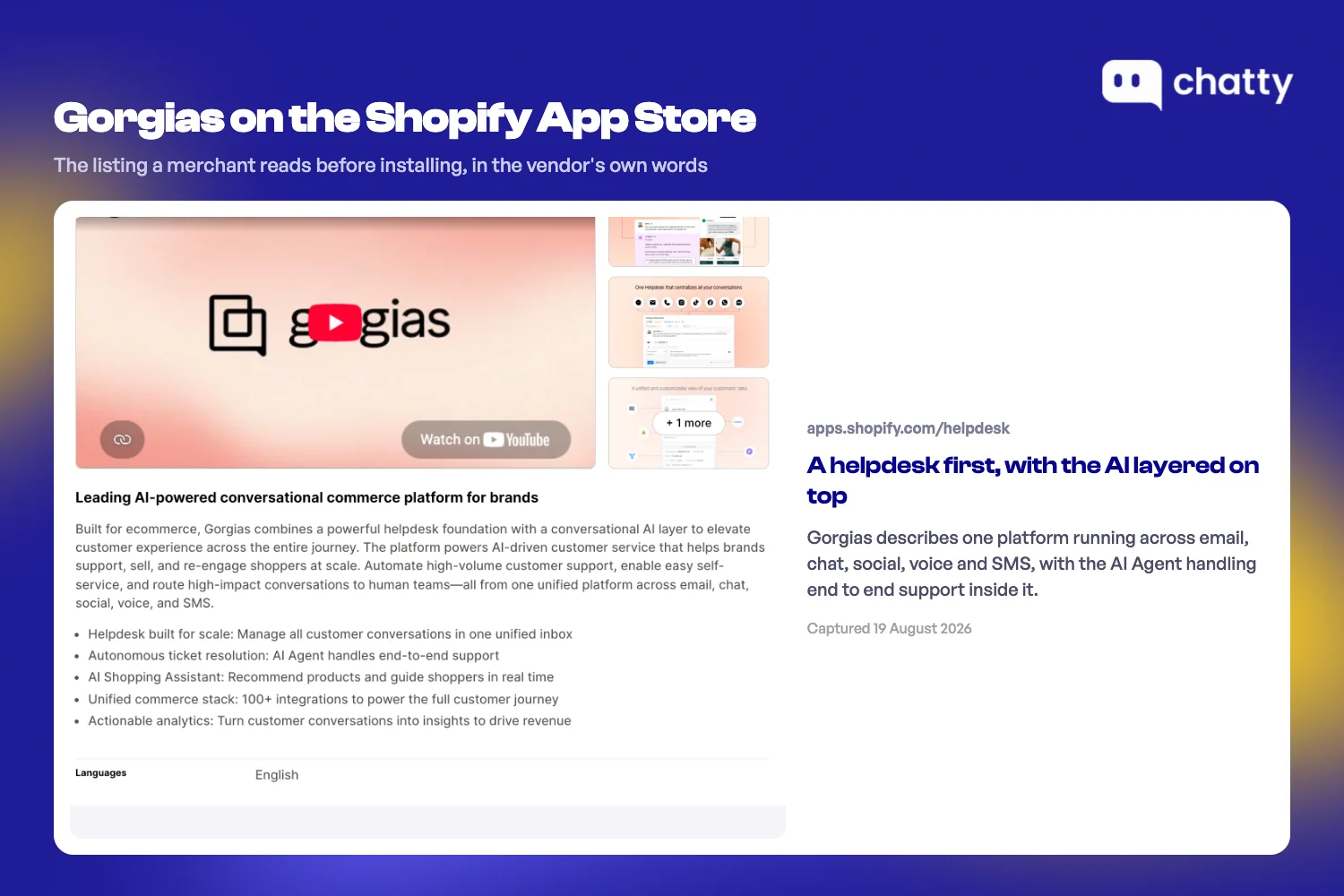
Chatty publishes this article, so read it that way. Every Gorgias figure below comes from gorgias.com, its own billing documentation, or its Shopify App Store listing, checked on 18 August 2026. Where Gorgias is the cheaper buy, that section carries arithmetic rather than a compliment.
- The meter is the comparison
Gorgias bills when its AI finishes a conversation and Chatty bills when one starts, and that single difference decides which is cheap on your store more than your traffic does.
- On Gorgias the bill climbs as the AI improves
A 500-conversation queue moving from a 40% to an 80% self-resolve rate adds about $300 a month to a Gorgias Basic bill and nothing at all to Chatty's Pro plan.
- On Chatty the improvement lands in revenue, not on the invoice
Stonehenge Health publishes $75,000 across 5,141 conversations, which is $14.59 a conversation against a Chatty Pro meter of about $0.14, so lifting what a conversation is worth costs you nothing extra.
- A fully automated Gorgias conversation is charged twice
It counts as one helpdesk ticket and one automation fee, unless the shopper needs a person within 72 hours, in which case only the ticket fee stands.
- Gorgias is genuinely cheaper on a quiet queue with a big team
Seats stop being metered from Basic up, so 15 people fielding under roughly 390 tickets a month at 20% automation pay less there than on Chatty's Plus plan. A bad AI month costs less on Gorgias too, because the vendor absorbs it.
What Chatty and Gorgias each decided to charge you for
Gorgias meters tickets and automated interactions. Chatty meters AI conversations.
Both threw out the model most support software still bills on, where the invoice tracks how many people you employ. What each put in its place is not the same unit at all.
Take the Gorgias side first. A ticket becomes billable the moment one message leaves your helpdesk, whether a person, a rule or the AI sent it. It stays one ticket no matter how long the thread runs.
If you have never had to think about what a support ticket actually is as a billing unit, this is where it starts to matter.
Chatty's side has only one unit. Human replies are unlimited on every tier, so the meter only moves when the AI speaks.
Each choice tells you which number the vendor agreed to be judged on. Both sides have a defensible reason for the unit they picked:
Why Gorgias prices the outcome
Gorgias only charges its automation fee when the AI closes a conversation without handing it to a person. If the AI gives up, you pay the ordinary ticket fee and nothing more.
That is a real promise with a real cost attached, and it is the right model when the value of an answer is the labor it replaced, because labor has a ceiling you already know.
You can work out what an agent costs per handled ticket, compare it to what Gorgias charges per resolved one, and decide before you sign. The vendor carries the downside of every answer that misses.
Why Chatty prices the attempt
Chatty charges for the conversation whether or not it ends well. In a month when the AI answers badly, you still paid for it, and that's the honest weakness of the model.
What you buy in exchange is an untaxed upside. A conversation that turns into a $200 order costs the same as one that goes nowhere. Every dollar you add to what a conversation is worth stays on your side of the ledger.
It also puts the vendor on the hook for whether those conversations were worth starting at all. A merchant who sees no return stops paying for volume.
There is a third position on this axis. MooseDesk does not meter AI replies at all and charges for tickets, seats and catalog size instead, which is a different bet again. The Chatty and MooseDesk comparison works through what that costs you elsewhere.
Chatty vs Gorgias pricing, verified August 2026
Two tables, not one. Merging them would imply the two companies count the same unit, and they do not.
Gorgias, from gorgias.com/pricing, verified 18 August 2026. Helpdesk on its own runs $10, $60, $360 and $900 a month, the figures its Shopify listing shows. The prices in the table below include the optional AI Agent add-on:
| Plan | Monthly | Annual, per month | Tickets | Automated interactions | Seats | Extra ticket | Extra interaction |
| Starter | $40 | Monthly only | 50 | 30 | 3 | $0.40 | $1.50 |
| Basic | $90 | $77 ($924 a year) | 300 | 30 | 500 | $0.40 | $1.50 |
| Pro | $550 | $471 ($5,652 a year) | 2,000 | 190 | 500 | $0.36 | $1.50 |
| Advanced | $1,430 | $1,227 ($14,724 a year) | 5,000 | 530 | 500 | $0.36 | $1.50 |
The included AI block divides out cleanly. Take Pro's $550 a month, subtract the $360 helpdesk, and the $190 left over buys 190 interactions, which is $1.00 each. The annual column prints its half of the split directly: $171 for the same 190 interactions, or $0.90 each.
Both rates turn up again in the billing FAQ further down that same pricing page, where Gorgias writes that "AI Agent interactions are priced at $0.90 each on annual plans or $1.00 on monthly plans." Read that against the plan cards above it, which all say $1.50 per automated interaction past your limit, and one page is quoting two prices for the same unit.
The gap between them is the overage, and the FAQ never says so. Which rate you pay depends on which half of the page you read, so the calculations below run the $1.50 card rate first and come back to the $0.90 FAQ rate afterwards.
Every plan carries a 7-day free trial, two of the four plan cards say no credit card required, and there is no free plan.
Chatty, verified August 2026. The meter here counts AI conversations, so read this table by conversation cap and catalog size rather than by seat:
| Plan | Monthly | AI conversations | Products the AI is trained on | Seats | Human chat |
| Free | $0 | 50 | 200 | 1 | Unlimited |
| Basic | $19.99 | 100 | 1,500 | 5 | Unlimited |
| Pro | $68.99 | 500 | 8,000 | 10 | Unlimited |
| Plus | $199 | 1,000 | Unlimited | Unlimited | Unlimited |
Past the cap, the paid plans charge $0.40 per additional AI conversation. The free plan has no overage at all, it simply stops at 50. It is permanent, and the paid plans carry a 7-day trial.
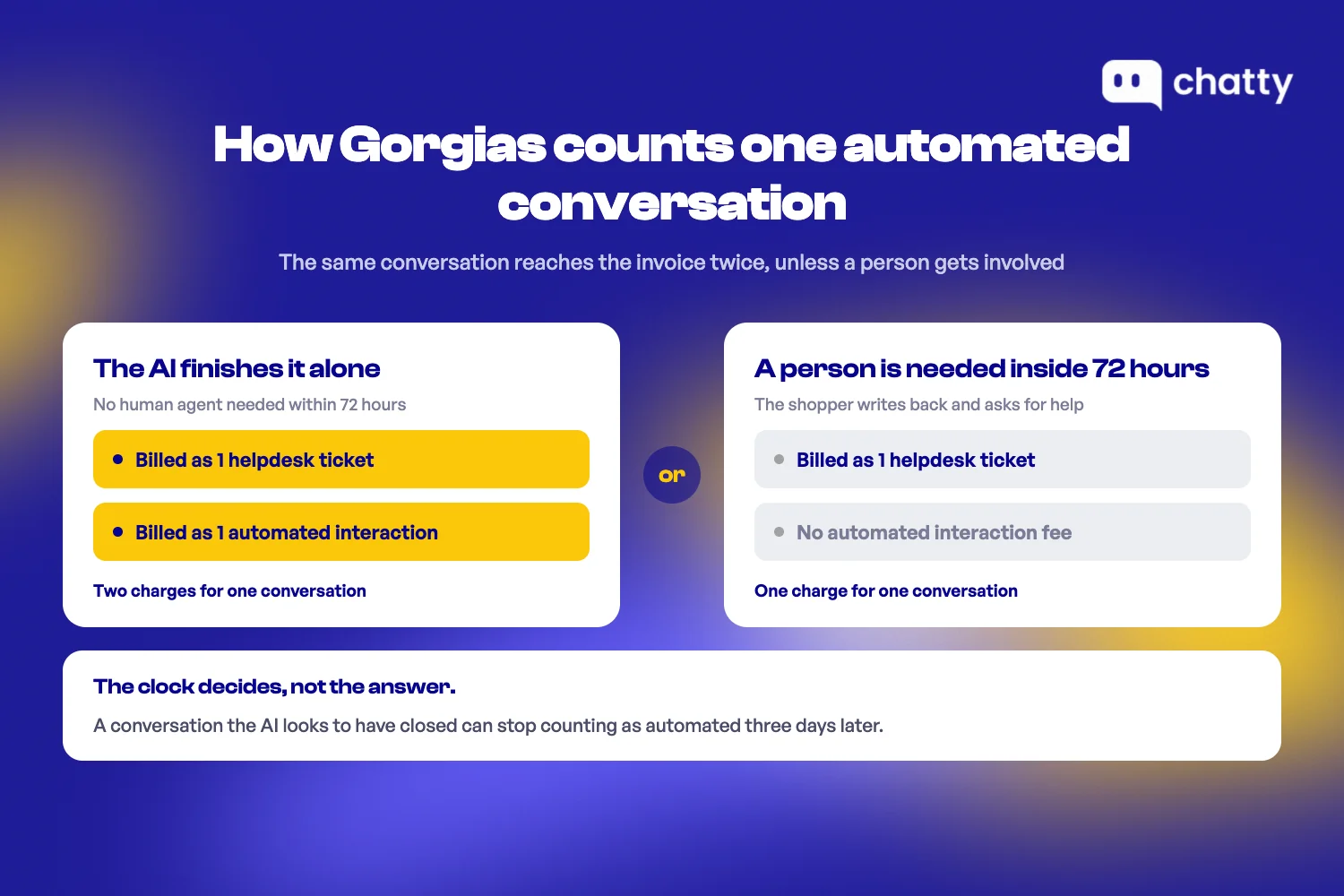
One Gorgias rule decides every calculation below. The company bills a fully automated conversation twice: once as a helpdesk ticket, once as an automation fee.
Gorgias states it in the billing FAQ on its pricing page ("Each AI Agent interaction also counts as a helpdesk ticket and is billed accordingly") and spells out the exception in its billing docs. If the AI hands the conversation to a person, only the ticket fee applies.
A second exception runs on a clock. An interaction only counts as automated "if the customer does not require the involvement of a human agent within 72 hours of the interaction." A shopper who writes back on day two, and needs a person, means the interaction never qualifies as automated in the first place.
Neither company invented these rules to be confusing, but the way AI chat gets priced rewards reading the counting rules before the price tags.
What the bill does when the AI gets better
Past the included allowances, it climbs on Gorgias and stays flat on Chatty. Both formulas are short enough to run your own numbers through:
- Gorgias: plan price + (tickets above the plan allowance × ticket overage) + (automated interactions above the AI allowance × $1.50)
- Chatty: plan price + (AI conversations above the cap × $0.40)
Three assumptions sit behind the table, all of them arguable. It treats one Gorgias billable ticket as one Chatty AI conversation. It assumes Chatty's AI opens every one of those conversations, which is the reading that puts the most conversations on Chatty's meter rather than the fewest. And it puts each side on its own cheapest eligible plan at monthly list price.
The self-resolve rate is the share the AI closes with no person involved inside 72 hours. That rate, not traffic, is the variable that moves the bill:
| Monthly volume | Self-resolve rate | Chatty | Gorgias |
| 100 conversations | 60% | Basic, $19.99 | Starter, $105 |
| 500 conversations | 40% | Pro, $68.99 | Basic, $425 |
| 500 conversations | 80% | Pro, $68.99 | Basic, $725 |
| 1,500 conversations | 60% | Plus, $399 | Pro, $1,615 |
Work the middle two rows yourself. At 40%, Gorgias Basic is $90, plus 200 tickets over the 300 allowance at $0.40, plus 170 interactions over the 30 allowance at $1.50, which comes to $425. At 80%, the same plan is $90, plus the same $80 of ticket overage, plus 370 interactions over the allowance at $1.50, which comes to $725.
Chatty's Pro plan covers 500 conversations at either rate, so it prints $68.99 twice.
Put those two rows side by side. Teaching the AI to handle four questions in five instead of two in five is a straight win for your support queue. It also adds $300 a month to the Gorgias invoice.
That is what pricing an outcome looks like when the outcome gets better, and it is Gorgias working exactly as advertised.
Give Gorgias its best case, though, because the overage rate is doing a lot of work here. The size of the allotment is the second thing Gorgias states two ways. The pricing page prints 30, 30, 190 and 530 across the four plans. Its own blog says plans include 90 to more than 2,500 automated interactions a month, with custom numbers for enterprise.
Every table above uses the pricing page figures, since those are the ones sitting next to a price you can click. If the blog range is the live one, buy the allotment rather than pay the overage.
The rate itself is the other half of that best case. Priced entirely at the annual $0.90 rate, the 500-conversation store pays $310 at 40% and $490 at 80%. The gap narrows to $180. It does not close, and the improvement still shows up as a line item on one side and not the other.
The same arithmetic runs the other way in two places, and in both of them Gorgias wins outright.
A bad month costs you less. Take that 1,500-conversation queue and let the AI slip from 60% to 15% after a catalog overhaul. The automation line falls from $1,065 to $52.50, so the invoice drops by more than a thousand dollars without anyone filing a ticket about it.
Chatty's $399 does not move, because the attempts were already paid for. The two models differ in who eats that risk, and here Gorgias eats it.
Big teams are cheaper. Gorgias stops counting seats from Basic up, at 500 of them. Chatty's ladder runs 1, 5, 10 and unlimited, so a 15-person team needs Plus at $199 whatever its chat volume.
Put 15 people on a quiet post-purchase queue at 20% automation and solve for the ticket count where Gorgias Basic matches Chatty's $199: $90, plus the tickets over 300 at $0.40, plus the automated interactions over 30 at $1.50. The two sides balance at about 390 tickets a month. Below that line a team of 15 pays less on Gorgias than on Chatty, whatever a feature comparison says.
Both of those hold, and neither one touches the other half of the ledger. Every calculation so far counts only what leaves your account. Switch the revenue side on and the same 500-conversation queue changes shape.
One published pair of numbers makes that side countable. Stonehenge Health, a supplement brand on Shopify, prints $75,000 of chat-attributed revenue across 5,141 conversations over seven months. Divide one by the other: $75,000 ÷ 5,141 = $14.59 of attributed revenue per conversation.
Read that figure narrowly. It belongs to one named merchant, self-attributed, over one seven-month window, on a catalog where the average order is $124.85. The divisor is every conversation on that store, the human-handled ones included, not only the ones the AI opened.
It is neither an industry benchmark nor a platform median, and a store selling $12 phone cases will land nowhere near it. Its job here is to put a real number on the revenue side instead of a placeholder.
The formula is conversations multiplied by revenue per conversation, minus the bill. Run the 500-conversation queue at Stonehenge Health's own rate, which no other store is owed, and $14.59 each comes to $7,295 against $68.99 on Chatty Pro. The meter works out to about $0.14 a conversation, under 1% of what those conversations returned at that rate.
Lift revenue per conversation by 20%, to $17.51, and the queue returns $8,755, which is $1,460 more a month against the same $68.99 invoice.
The same improvement pulls two levers on Gorgias and one on Chatty. A sharper AI closes more conversations alone, which is the event Gorgias bills, and it sells more, which is the event you wanted. Only the second of those shows up when you pay per conversation, because nothing on the invoice grows when the answers get better.
So the crossover point is not a traffic number at all. Two numbers set it, and you already have both.
What one answered question earns you argues for the model that does not tax the answer. How many people share your inbox argues for the model that does not tax the seat. Whichever number is larger on your store is the one to price against.
Why each product reports a different number
Each vendor leads with the number its own meter depends on, so you can read the pricing model straight off the customer pages.
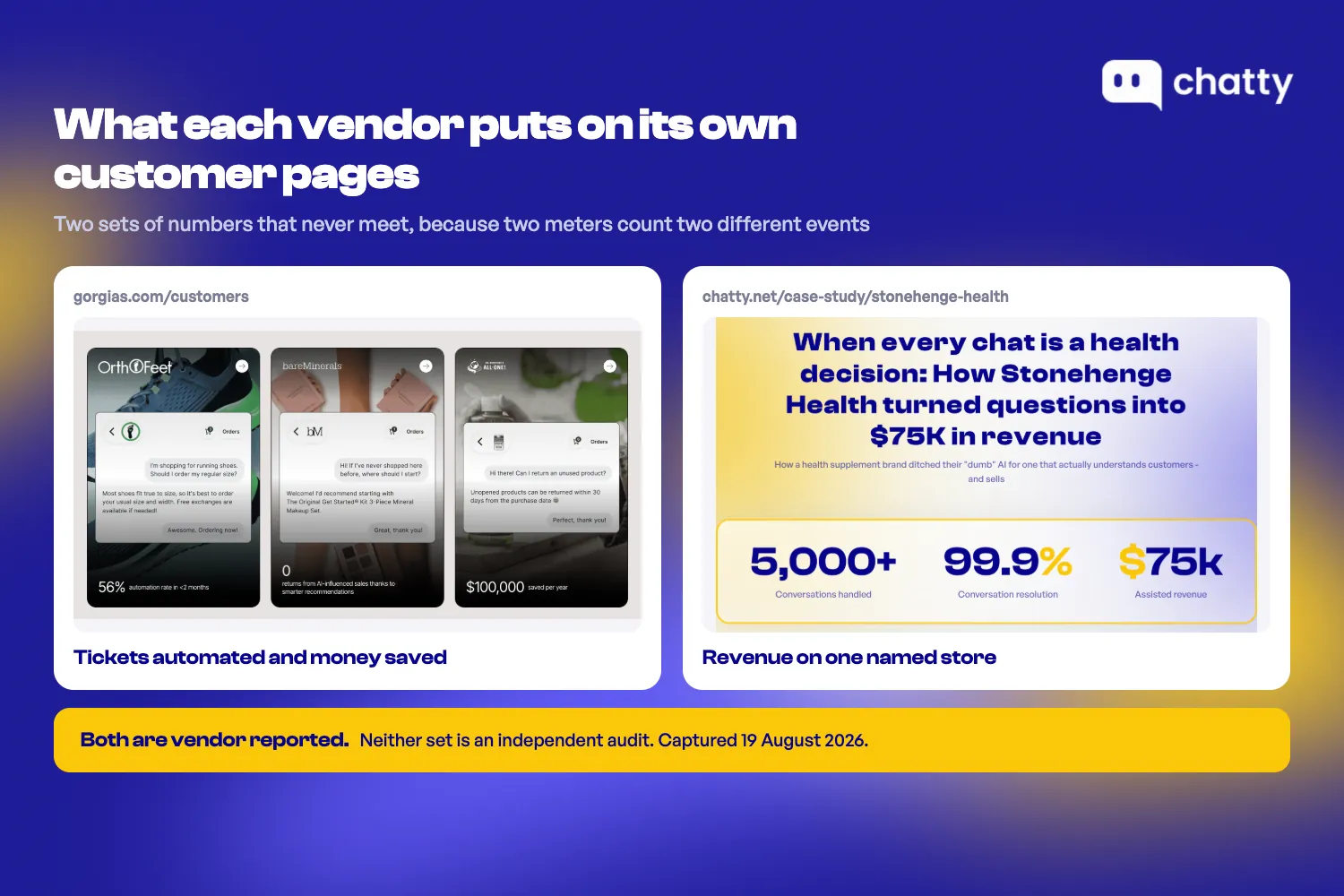
Gorgias leads with automation and cost. Its pages give you Orthofeet at 56% of tickets automated inside two months, Pepper at 54% of support automated with 19% of conversations converted, and Arc'teryx at 23x ROI on AI Agent.
It publishes commercial numbers too, including £885,000 of GMV influenced at The Diamond Store in 90 days. A pure deflection tool would not have that number on its site.
Chatty leads with revenue per named store, and publishes the raw counts underneath it. Stonehenge Health reports $75,000 in chat-attributed revenue across 5,141 conversations over seven months, 99.9% of them resolved, at an average order of $124.85. BARABAS, a US menswear brand, reports $300,000 of AI-attributed revenue in its first year and 800 purchases assisted by the AI.
Both pages name the brand, the industry and the window, which is what the pricing model forces. Bill per conversation and the thing you have to prove is that the conversation was worth having.
Three things apply to both columns before either one persuades you:
Both are vendor-reported. Orthofeet's 56% and Stonehenge Health's $75,000 come from the same kind of source, which is a vendor writing about its own customer. A named merchant is more checkable than an anonymous percentage, and neither is an audit. Discount both evenly.
Neither set is a rate you will get. Orthofeet's automation rate is Orthofeet's catalog and Orthofeet's question mix. Stonehenge Health's $14.59 is a supplement basket at $124.85 an order. Treat every figure on both sides as proof the number is achievable somewhere, not as a forecast for your store.
An automation rate is not an accuracy score. It counts conversations that closed without a person. It says nothing about whether the answers were right, and it is an easy number to misread as accuracy. Whether those closed conversations were any good is a separate measurement, and that is closer to what chatbot analytics are for.
Notice the loop on each side. Gorgias's flagship metric is the same quantity its invoice scales with, so its case studies and its invoices measure the same event. Chatty's flagship metric is the one its invoice ignores, so its case studies measure something the meter never sees.
Both loops are honest. They follow from one company pricing an outcome and the other pricing an attempt, which is also why you cannot lay the two sets of numbers on top of each other.
Where the two products genuinely do not overlap
Some differences the pricing axis explains. These it does not. Every line below is what each vendor documents on its own live pages, which is why there are no blanks:
| Dimension | Gorgias documents | Chatty documents |
| Platforms | Shopify, WooCommerce, BigCommerce from Basic, Magento from Pro | Shopify |
| Channels | Email, live chat, contact form, Facebook, Instagram, TikTok Shop, WhatsApp, plus Voice and SMS as paid add-ons | Web chat, email, Messenger, Instagram, WhatsApp |
| Ticketing | Helpdesk tickets are the billing unit, from 50 for $10 a month on Starter | Email tickets in a Helpdesk on every plan, not metered |
| Seats | 3 on Starter, 500 from Basic up | 1, 5, 10, then unlimited on Plus |
| Integrations | A 254-app library plus HTTP and custom integrations | Shopify catalog, cart and orders |
| Catalog ceiling for the AI | No product ceiling on the pricing page | 200, 1,500, 8,000, then unlimited on Plus |
| Way in at $0 | 7-day free trial on every plan, no free plan | Permanent free plan, 50 AI conversations a month |
Read the catalog row the right way round. Gorgias does not price by catalog size, so it has no ceiling to publish.
Chatty does, so the ceiling appears tier by tier and you can check your product count against it before you pay. Two billing units produce two different documents, and neither one has a hole in it.
The ticketing row follows the same logic. Gorgias counts tickets because tickets are what it bills.
Chatty Helpdesk turns email to your connected address into tickets with a priority from Low to Critical and an assignee. Any Inbox conversation can also be converted into a ticket from the desktop app. Those tickets do not touch Chatty's meter, which only counts AI conversations.
Gorgias's side of that table is the side a growing support organization eventually needs. You get Voice and SMS in the same inbox, plus SSO on every plan and audit logs from Pro. There are ten help centers on top of that, unlimited connected stores, and a seat count that stops being a budget line at all.
Its Pro plan carries a "12,400+ brands" badge, and the platform has been sold to enterprise CX teams for years. That shows in how much of the list above is about governing a team rather than answering a shopper.
Gorgias has been building ecommerce helpdesk software since 2015, and it is one of the established names in the AI helpdesk market now. That is the job it is built for.
Chatty's side is narrower on purpose and just as specific. The AI trains on the Shopify catalog itself, with no product cap on Plus. It answers from live product data and stock levels rather than a knowledge base you maintain by hand.
Recommendations arrive as a product card inside the conversation, with an add-to-cart button on it and a "view similar" button for when the first match is wrong.
On-site campaigns fire by page type, and each one narrows further by audience, device, display time and display duration. The proactive chat report totals impressions, engagement, orders and revenue, with views and click-through rate broken out campaign by campaign. All of it assumes a shopper who has not bought yet.
The middle of that axis is crowded. Both answer on web chat, Messenger, Instagram, WhatsApp and email, both track orders, both run a help center, both recommend products, and both hand a conversation to a person. Counting features will not separate them.
Which one fits your store
Three questions decide it:
Does your chat happen before the purchase or after it? Before, and the value of an answer is an order, which has no ceiling and no forecast, so paying per attempt keeps that whole upside with you. After, and the value is a cost you avoided, which has both a ceiling and a forecast, so pay for outcomes when the outcome is a known saving.
If most of your chat is pre-purchase, your catalog sits on Shopify and your team is small, Chatty is the buy and the other two questions are detail.
How many people will share the inbox in a year, and do you need SLAs, routing, SMS or voice? If the honest answer is a growing team that needs those things, buy Gorgias. Seats stop costing money from Basic up, and that is arithmetic, not preference.
One Shopify store, or several platforms? Chatty runs on Shopify. If your catalog also lives on WooCommerce or BigCommerce, Chatty is not in the running at any price.
If what you actually wanted was a shortlist rather than a head-to-head, the roundup of tools merchants move to from Gorgias covers nine of them properly.
This article also skips the side-by-side capability grid, because the Chatty and Gorgias feature comparison already answers what each product has. This one answers which pricing model your store should want.
Both companies are right inside their own territory. Gorgias built a mature helpdesk, prices it against the labor it removes, and takes the risk when its AI misses.
Chatty built a Shopify sales agent, prices the conversation, and leaves the upside of a good one alone. Neither wins in the abstract.
The cheapest way to settle it is to stop reading and go measure. Run Chatty's free plan for a month on 50 AI conversations, and count how many ended in an order rather than a closed ticket.
Multiply that count by your average order value, then put the result next to whichever bill you're paying now. If the first number is not comfortably larger than the second, no pricing model saves you.
Frequently asked questions
It depends on two numbers, not one. Ask what share of conversations your AI closes without a person, and how many people share your inbox. At 500 conversations a month with a 40% self-resolve rate, Chatty's Pro plan is $68.99 and the cheapest Gorgias configuration is about $425 on monthly billing, or about $310 on annual. Flip to a 15-person team fielding 200 tickets a month at a 20% self-resolve rate and Gorgias is the cheaper of the two, at roughly $105 against Chatty's $199. Neither answer generalizes, which is why both formulas are in this article.
Yes, as an optional add-on on top of the helpdesk plan. The billing FAQ on Gorgias's pricing page puts an interaction at $1.00 on monthly billing or $0.90 on annual, and the included blocks on the plan cards divide out to exactly those rates. The same cards then price anything past the block at $1.50, which the FAQ does not mention. The counting rule matters more than the rate: a conversation the AI finishes alone is billed as one ticket and one automation fee, while a conversation it hands to a person is billed as a ticket only. Gorgias also stops counting the interaction as automated if the customer needs a human within 72 hours.
Technically yes, and merchants do it during an evaluation. Just be clear about where it costs you. Two widgets on one storefront split your chat history across two inboxes, and any conversation both tools touch is metered twice, once as a Chatty AI conversation and once as a Gorgias ticket. Running them in sequence for a billing cycle each is cheaper and gives you a comparison you can actually read.
If you're keeping Gorgias only to have chat and email tickets in one place, Chatty covers that alone. Its Helpdesk turns support email into tickets inside the same app as the chat Inbox.
Chatty now includes a Helpdesk on every plan, including Free. Email sent to a connected address becomes a ticket with a priority, an assignee and a status. Agents can reply, send and close, send and snooze, forward or leave an internal note.
For a small Shopify team whose chat is mostly pre-purchase, that covers the ground. For a larger operation it does not.
Chatty's Helpdesk does not document macros, automation rules, SLA policies or helpdesk reporting. Its tickets come from email or manual conversion rather than social channels.
Gorgias documents Voice and SMS channels, 500 seats from Basic up, SSO and audit logs, ten help centers, and support for WooCommerce, BigCommerce and Magento. If your shortlist requires any of those, this is not a like-for-like swap and no pricing argument makes it one.
An interaction where a customer request is fully handled by AI Agent or another automation feature, with the added condition that "the customer does not require the involvement of a human agent within 72 hours of the interaction." Emails that get no reply, spam and conversations a person resolved do not count. That 72-hour window is why a conversation the AI looks to have closed can stop counting as automated three days later.