









Ask in any Shopify forum the week after BFCM and the question comes back the same shape. The sale brought a flood of first-time buyers, keeping them is where it falls apart, and the replies name the same three fixes. An email flow. Loyalty perks. A subscription push. All marketing.
Buyers leave for plenty of reasons, and once the sale ends you cannot touch most of them. The question you never answered is the one you still can.
Timing is what makes it urgent, and BFCM supplies the numbers. Of all the repeat orders BFCM first-time buyers place, 70% land inside the first 30 days (BS&Co, 8,076 first-time buyers). From December to February, return volume rises an average of 44.5%, while most retailers expect a 10% increase (Returnless).
The window that decides your second order is the window where that wave starts.
Your strategy for those four weeks has two jobs:
- Answer the questions that arrive after the money did.
- Earn the second order before the window shuts.
You already pulled the revenue numbers. Here are the three nobody tells you to pull.
- The window that decides your second order is only 30 days wide
70% of the repeat orders BFCM first-time buyers place land inside the first 30 days, against 50.3% for the same brands' year-round buyers.
- Your usual second-order email is timed for the wrong clock
A nudge borrowed from a 60 or 90 day cycle arrives after the window has shut. Pull it forward to around day 21 and split it by delivery status.
- The returns wave is bigger than most stores plan for
Return volume rises an average of 44.5% from December to February, while most retailers expect around 10%.
- One in eight peak-week questions was already about something after the sale
After-sales questions made up 11.8% of classified conversations, measured during the eight peak days themselves, while most parcels were still moving (Chatty conversation data, Nov 24 to Dec 1, 2025).
- Over half the demand lands outside business hours
53% of peak conversations arrived outside 9am to 6pm UTC, in the weeks your team is most stretched.
- Two of the ten most common questions never need a person
Your return window and who pays return shipping can be answered in full by a system, as long as the returns policy exists as plain text a system can read. A JPG of your policy is invisible to chat, to search, and to the AI assistants shoppers now ask first.
- Three cases should never be automated
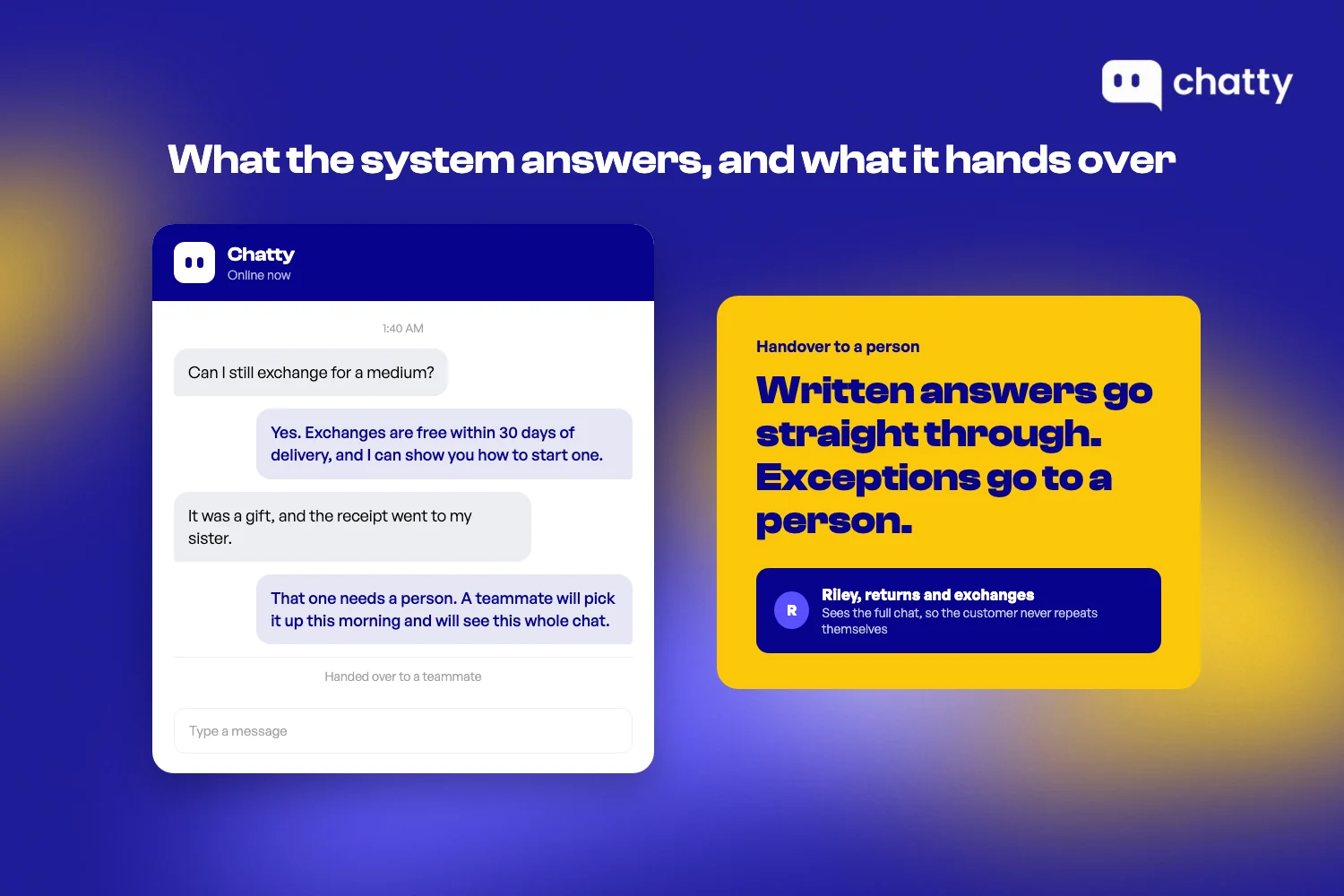
Send a person to a refund outside policy, a refused claim, and an angry customer threatening a chargeback or public review.
Three numbers to pull this week
Revenue, AOV and ROAS tell you what the sale did. They cannot tell you what happens next. All three were recorded before the experience your customers will judge you on, because delivery, returns and questions come after the money. Three service numbers cover that gap. Pulling them takes an afternoon.
One. What share of your sale-week questions were already about something after the sale.
During the 2025 peak, after-sales questions (returns, warranty, complaints) made up 11.8% of classified conversations, about one in eight (Chatty conversation data, Nov 24 to Dec 1, 2025).
That covers the eight peak days only, not the weeks after, and that is what makes it useful. One in eight questions was already post-sale during the sale itself, while most parcels were still moving. Whatever your own share is, it is the floor (see the full BFCM 2025 conversation breakdown).
Count yours the same way. Tag every sale-week conversation pre-sale or post-sale, and read the ratio. What fills that pile depends on what you sell:
| If you sell | Your post-sale pile fills with | Because |
|---|---|---|
| Apparel and accessories | Sizing and exchange requests | A size chosen from a photo is a size that comes back |
| Home and hardware | Assembly and compatibility questions | They arrive after the box is open, and a policy page cannot answer them |
| Beauty and supplements | Delivery timing and suitability | A slow first answer costs the reorder, which is the whole model |
Two. What share of it landed outside your working hours.
More than half. In that same peak window, 53% of conversations arrived outside 9am to 6pm UTC. That is a global base across many time zones, so read it as shape, not as a clock reading for your store.
Roughly half the questions after a peak arrive when nobody is at a desk, in the weeks your team is most stretched. That gap is what 24/7 customer support has to cover.
Three. How many questions nobody ever answered.
No industry benchmark exists for this one, and it does not need one. You measure it against yourself:
- Filter your last sale for conversations with no staff reply, or a reply that came more than 24 hours later.
- Write the number down, then measure the same thing after the next sale.
Nobody outside your store can say what a good number is. You can see whether yours is going up.
What flows, perks and subscriptions can and cannot do after a sale
All three work. They are also timed for regular customers, who buy on a slower clock, and they answer a different question from the one that decides the second order.
The email flow works, and most are timed wrong. 70% of BFCM repeat orders land inside 30 days. For the same brands' year-round buyers, the figure is 50.3% (BS&Co).
Sale buyers move on a faster clock, so a second-order nudge borrowed from your normal 60 or 90 day cycle arrives after the window shut. Two changes fix the timing:
- Pull the send forward to around day 21, inside the window instead of after it.
- Split the flow by delivery status if your stack allows it. A promotion landing on someone whose parcel has not arrived is worse than no email.
Last year's BFCM playbook already died once on the assumption that more sending solves more problems.
Perks work, and shipping beats points. 65% of shoppers want free or faster shipping and 59% want points (Attentive). A free shipping threshold beats another discount for this cohort. These people already came to you for price, and another 15% off teaches them to wait for the next sale.
If your sale sits in front of a delivery deadline, run the threshold before your shipping cutoff, not after. Otherwise nobody can use it in time.
Subscriptions work for a narrower group, and timing is the lever. If you sell something consumable on a predictable cycle, coffee, supplements, skincare, pet food, this is the strongest retention tool you have. Offer it after the first delivery lands, not on the thank-you page.
For a BFCM order that puts the invitation in the middle of your busiest support weeks, so it has to survive being read quickly.
Now the assumption all three share: that the customer left because you did not send enough.
Be honest about why people leave. Price. The product did not fit. The discount that brought them in expired. A competitor went cheaper. They did not need a second one. You cannot fix any of those once the sale has ended.
The unanswered question is the exception, the one reason on that list still inside your control during the weeks that decide the second order. It does not have to be the biggest cause to be worth fixing.
The wave runs on a predictable clock, whatever the sale is called. The order ships in your busiest shipping week, moves through a carrier network you just overloaded, and two to four weeks later it is late, or wrong, or the wrong size, or it needs to go back. That is the second wave, and by then any extra help you brought in has gone.
Merchants underestimate how big it gets. Four numbers set the scale:
- +44.5% average rise in return volume from December to February, while most retailers expect around 10% (Returnless).
- 52% of retailers start preparing only one to two months ahead (Returnless).
- 52% name capacity as their biggest challenge, the same study.
- 12.2% of online orders returned globally between January 1 and 14, 2026, up 3% year over year (Salesforce, reported by Digital Commerce 360).
Rates vary by category, so check your own benchmark before you plan headcount.
Every one of those returns starts as a question. The ticket arrives days before the box does.
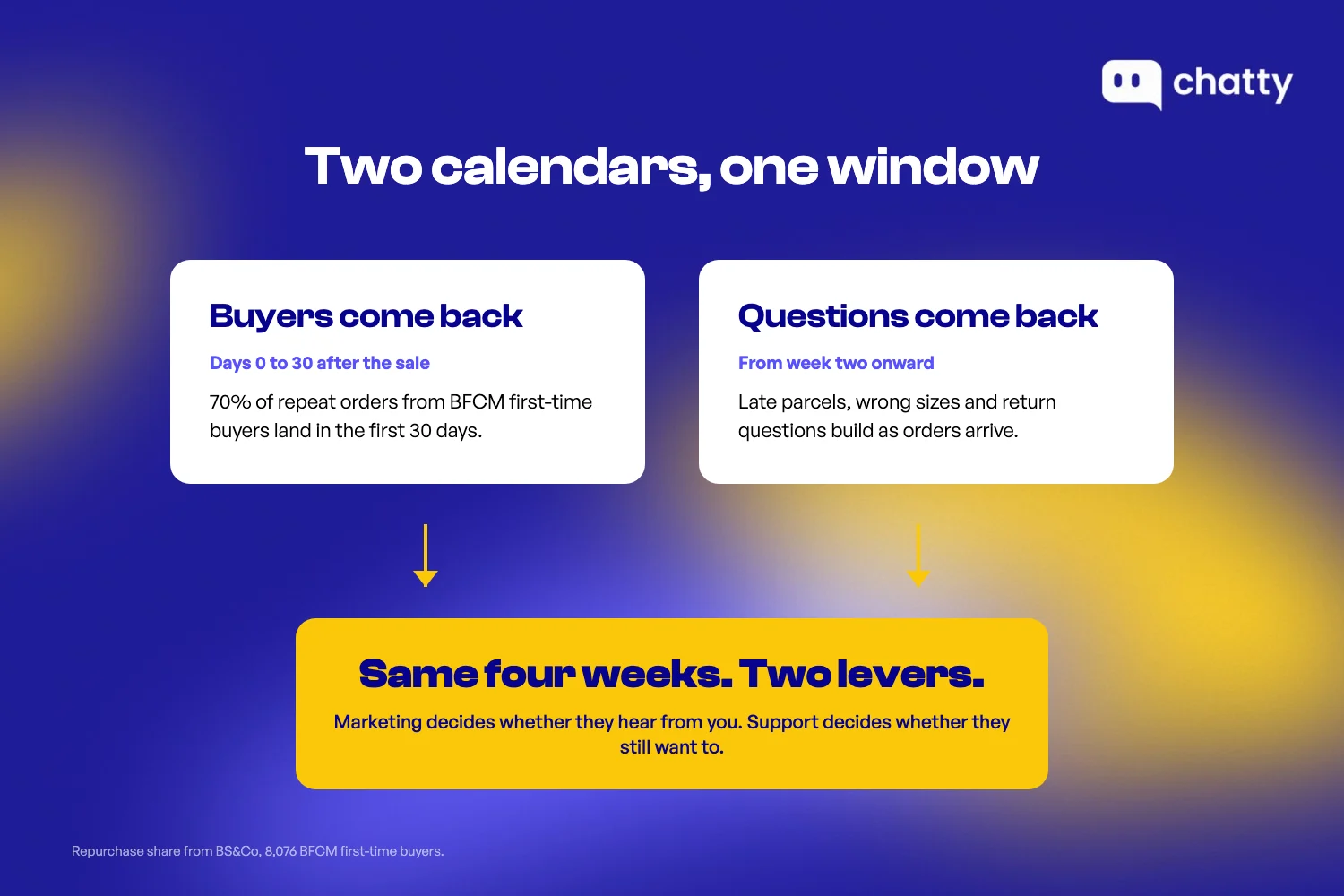
So put the two calendars on top of each other. The 30 days after a sale is when the repurchases happen, 70% of them in the BFCM data. It is also when the second wave lands. Same window, two levers. Marketing decides whether they hear from you. Support decides whether they still want to. Only one of the two usually gets a budget line.
Zendesk's 2026 CX Trends report puts it bluntly: "One unsolved issue now costs brands a customer for life." The key word is unsolved. Something the customer needed never got finished. The same report found 74% of consumers find it very frustrating to repeat themselves, which a post-sale inbox almost guarantees.
Agentic CX is every step of the buyer's journey, and the only score that counts is what got resolved.
The ten questions your inbox is about to ask, and who answers them
These ten come from the question groups that dominated BFCM 2025: order and account questions at 26.1% of classified conversations, product recommendations at 19.3%, after-sales at 11.8%, comparisons at 8.7%, and promotions and codes at 8.5%.
Write your store's answer to each in your knowledge base, then decide in advance which a system handles and which need a person. This is what any support setup should do, whoever builds it.
| # | Question | Should a system answer it | Send it to a person when |
|---|---|---|---|
| 1 | Where is my order? | Yes, if it can read live order and tracking data | Tracking says delivered and the customer says it was not |
| 2 | Did my order go through, I got no email | Yes. Confirm the order exists and resend the receipt | The payment shows as taken with no order attached |
| 3 | Can I change the delivery address? | Yes, for the rule and the cutoff | The edit itself, once the order is picked or shipped |
| 4 | Can I cancel this order? | Yes, for the window and how to do it | The request lands after dispatch |
| 5 | Will it arrive by the date I need it? | Yes, from a published cutoff date and current lead times | The customer needs a guarantee you have not published |
| 6 | My code did not work, can you apply it now? | Yes, for the rule and the conditions | Applying it after the fact, which is a money decision |
| 7 | What is your return window, and does it change for gifts? | Yes, in full, if the policy exists as plain text | Never, if the policy is written properly |
| 8 | Do I pay return shipping? | Yes, in full | Never, once it is written down |
| 9 | Can I exchange for another size instead of a refund? | Partly. It can explain the rule and the steps | The exchange has to be created or the stock is gone |
| 10 | Which of these two should I get, and will it fit? | Yes, if somebody wrote the sizing and comparison content | High value, custom or made-to-order items |
Three cases no system should decide alone:
A refund outside your policy. The rule is easy to state. The exception is a judgment call about what this customer is worth. Do not let a machine guess at it.
A refused claim. Saying no is the hardest message in support, and explaining why in a way people accept is harder still. Most automated setups, ours included, cannot do this well today. Route it to a person who has the history.
An angry customer threatening a chargeback or a public review. Tone matters more than accuracy here. That is a person, every time.
Look at rows 7 and 8. Two high volume questions never need a human at all, as long as the policy exists in plain text a system can read. A JPG of your returns policy is invisible to your own chat, your help center search, and the AI assistants customers now ask first.
Everything in the last column needs somewhere to go that is not the back of the live chat queue. In Chatty, an agent converts the chat into a Chatty Helpdesk ticket and sets the priority. A chargeback threat is Critical, while a size exchange can be Medium.
The ticket is then assigned to whoever owns refunds, with an internal note on what the customer has already been told.
Your post-sale timeline, day 0 to day 30
Marketing calendars for these weeks already exist. This is the service side, which nobody publishes. Day 0 is the day your sale ends. One action per stage, one owner, one test for done.
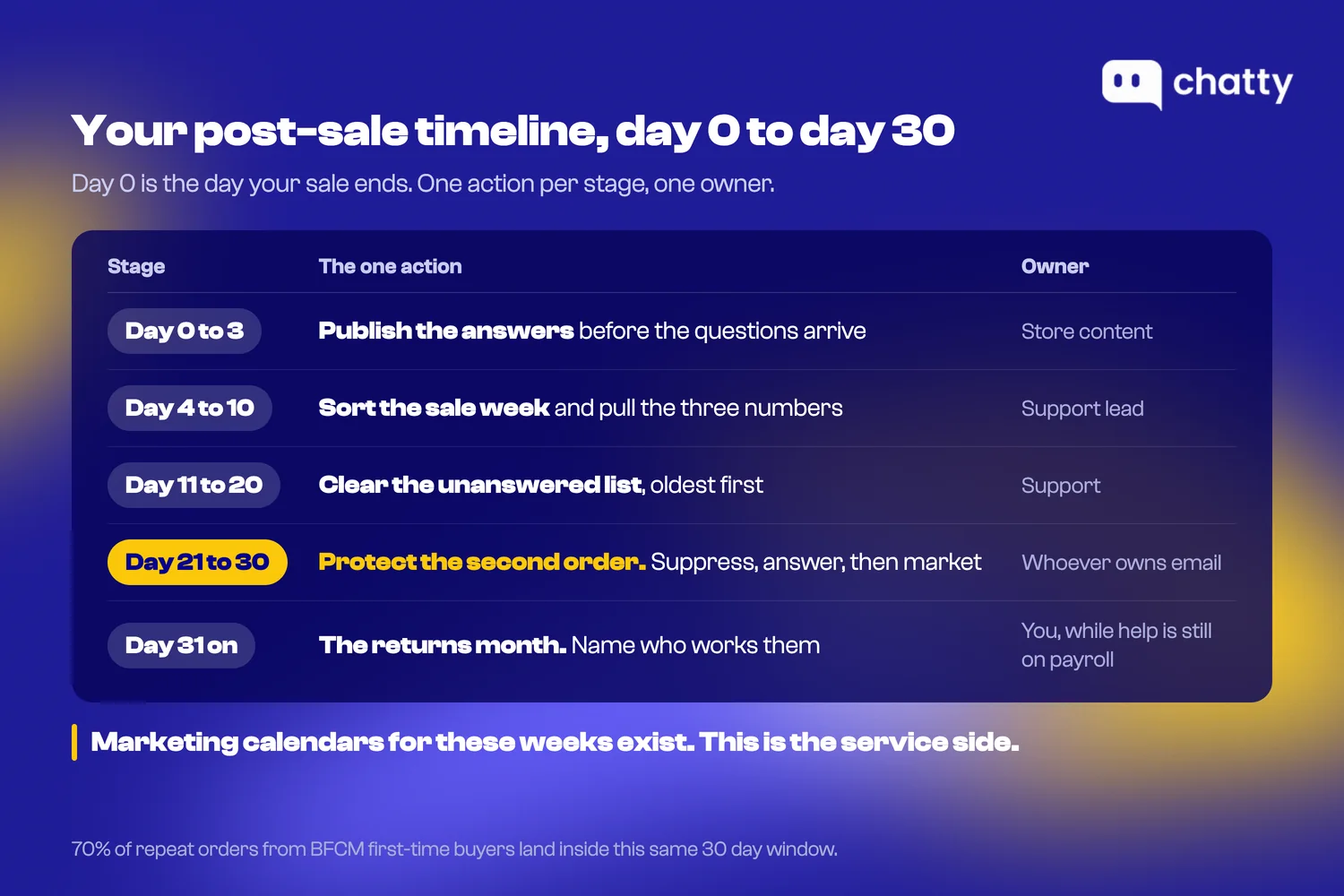
| Stage | The one action | Owner | Done when |
|---|---|---|---|
| Day 0 to 3 Publish the answers before the questions arrive | Put the shipping cutoff, the returns window, who pays return shipping and the exchange rule into plain text where shoppers ask: product page, cart, chat. | Whoever controls store content | A shopper at midnight gets the cutoff date without waiting for anybody |
| Day 4 to 10 Sort the sale week and pull the three numbers | Tag the sale week's conversations pre-sale or post-sale, count the after-hours share, and list every conversation nobody answered. | Support lead, or the founder if that is the same person | The numbers are written down and the unanswered list exists |
| Day 11 to 20 Clear the list and get ahead of the second wave | Work the unanswered list, oldest first. Then message every order that has not moved in a week, before the customer has to ask. | Support | No conversation is older than 48 hours without a reply |
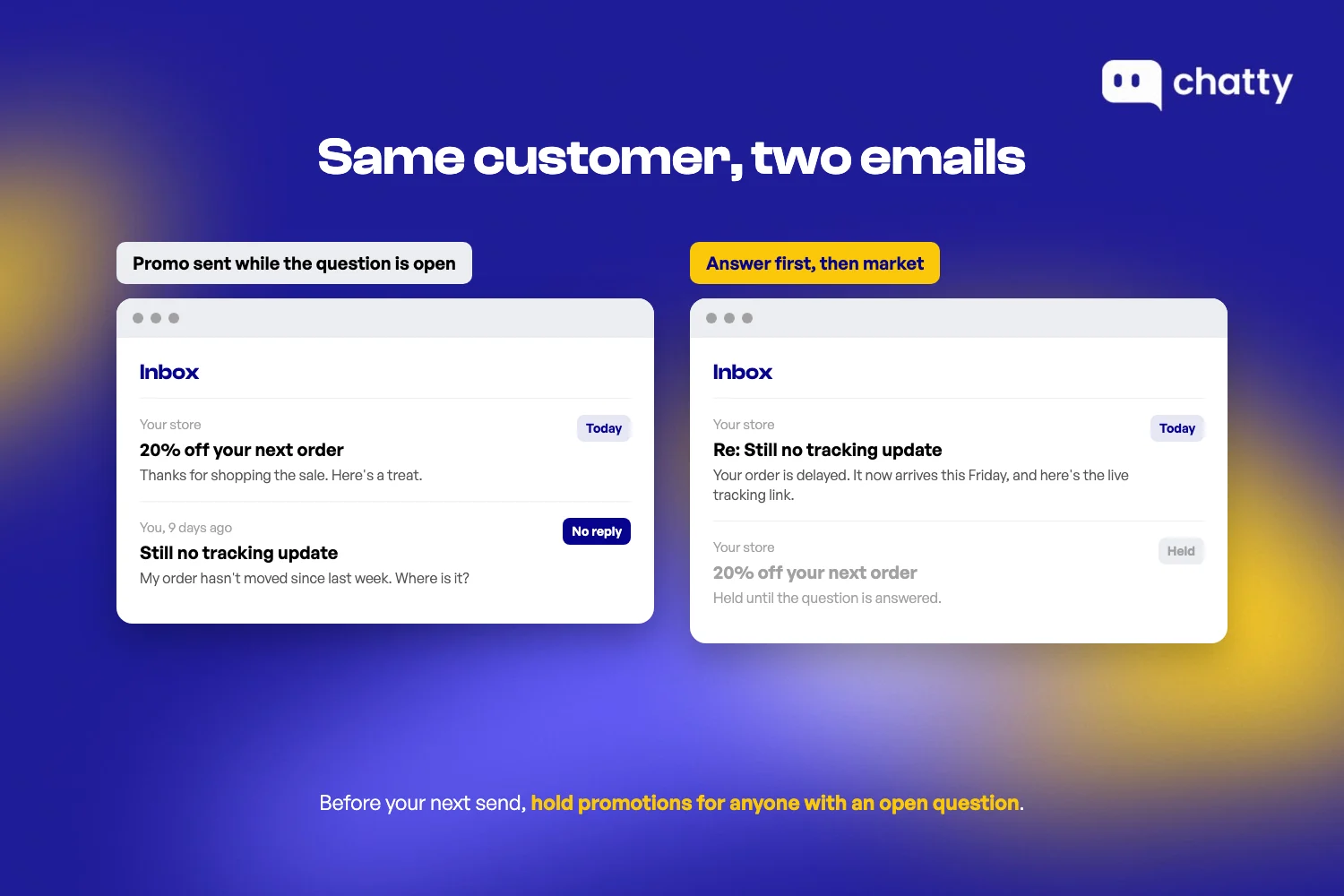
| Day 21 to 30 Protect the second order | Repurchase decisions cluster here, so make sure nobody with an open ticket receives a promotion. Suppress, answer, then market. | Whoever owns email, working from the support queue | The suppression rule is live before the next send |
| Day 31 onward The returns month | Returns peak in January, after the window most stores plan for. Decide who works them before any temporary help leaves, and publish the return window answer in the same plain text as the rest. | You, while those people are still on payroll | Every return question has an answer and a name against it |
That last row is the one most stores leave open. If it is still open for you, our breakdown of seasonal hiring versus scaling with AI works through the trade.
What to do first if you cannot do all of it
Most stores will not do all of the above in the four weeks they have. Sort it into three piles and work top down.
- Blocks revenue, so fix it today. Anything a shopper needs before they buy: the shipping cutoff, whether it arrives in time, whether the code works. Every hour these stay unanswered is checkout traffic walking away. They are also the cheapest to fix, because the answers are factual.
- Blocks trust, so fix it this week. The unanswered list, the returns policy in machine-readable text, and a visible route to a person outside business hours. None of it shows up in this month's revenue. All of it shows up in next quarter's. The stage-by-stage guide to BFCM customer experience covers these in detail.
- Can wait until after the window closes. A loyalty program rebuild, a subscription launch, a new help desk, a macro rewrite. All worth doing, none worth doing in the four weeks that decide whether your sale buyers order again.
This is the pile Chatty was built for. If your questions land at hours you cannot staff, you need your published answers to reach the shopper asking at midnight, and a fast route to a person for anyone the system cannot help.
Do this today
Back to the merchant in that forum thread. The flow, the perk and the subscription all work. They just cannot do their job while the question is still open.
Five steps, in order:
- Count the conversations from your last sale that nobody answered. That is your baseline.
- Put your returns window, return shipping rule and shipping cutoff into plain text, in the three places shoppers ask.
- Write your store's answer to the ten questions above, and mark which ones go to a person.
- Suppress promotions to anyone with an open ticket before your next send.
- Name who works the returns wave, while any temporary help is still on payroll.
The first takes twenty minutes. Do it before you plan anything else.
Frequently asked questions
Count the conversations from your last sale that nobody answered, or that got a reply more than 24 hours later. It takes about twenty minutes and it is the only number on this page you cannot get from anywhere but your own store. Everything else you might do, the email flow, the loyalty perk, the subscription launch, works better once you know how big that pile is.
About 30 days. 70% of the repeat orders BFCM first-time buyers place land inside the first 30 days, against 50.3% for the same brands' year-round buyers. Sale buyers move on a faster clock, which is why a second-order nudge timed for a normal 60 or 90 day cycle arrives after the window has already shut.
Around day 21, rather than the day 60 or day 90 your usual flow assumes. Split the send by delivery status if your stack allows it, and suppress anyone with an open support ticket. A promotion landing on somebody whose parcel has not arrived, or whose question has gone unanswered for nine days, does more damage than sending nothing.
Return volume rises an average of 44.5% from December to February, while most retailers expect around 10%. The same research found 52% of retailers start preparing only one to two months ahead, and 52% name capacity as their biggest problem. Rates vary a lot by category, so check your own benchmark before you plan headcount.
Anything with a written answer behind it: the return window, who pays return shipping, the shipping cutoff, whether a code applies. Return policy questions in particular never need a human, as long as the policy exists as plain text rather than a JPG. Order lookups also work, provided the system can read live order and tracking data.
Three. A refund outside your policy, because the exception is a judgment call about what that customer is worth. A refused claim, because saying no in a way people accept is the hardest message in support. And an angry customer threatening a chargeback or a public review, where tone matters more than accuracy.
Price, fit, an expired discount, a cheaper competitor, or simply not needing a second one. You cannot fix any of those once the sale has ended. The unanswered question is the exception, the one reason still inside your control during the exact weeks that decide the second order.