










Last updated October 12, 2026. Every price, rating and review count in the table and the cost section was re-checked that day on each app's Shopify App Store listing.
Ten live chat apps for Shopify sit at the top of the App Store, and their prices look comparable, but they are not. Each one meters something different: agents, tickets, conversations, AI conversations or bundles of seats. So a $29 plan and a $31 plan can be four times apart once you have two people and real traffic.
A bigger split sits underneath. Nine of these ten are built to close tickets, and one is built to close carts. Start with the table, then see what each costs at real volume.
Best Shopify live chat apps compared at a glance
Read the price and the unit as one thing. On their own the numbers in the third column are not comparable.
| App | Best for | Starts at, and the unit | Free plan | AI resolves alone? | Order actions in the chat | Rating |
| Chatty | Sales-first chat plus email Helpdesk | $19.99, per AI conversation | Yes, 50 AI conversations | Yes | Adds and removes cart items, order lookup, recs | 4.9, 1,877 reviews |
| Tidio | Chat plus help desk | $29, per conversation. AI sold separately from $39 | Yes, 50 users | Yes | Order status, cart preview, recs. Cancel and refund on Growth | 4.8, 1,354 |
| Richpanel | Helpdesk, AI-native | $89, per seat | No, 14-day trial | Yes | Order status, returns, refunds, cancellations, subscriptions | 4.9, 137 |
| Gorgias | Helpdesk at scale | $10, per ticket | No, 7-day trial | Yes | Order tracking, cancellations, returns, subscription edits | 4.3, 704 |
| LiveChat | Chat-first, sales-angled | $25. The listing states no unit | No, 14-day trial | Its two pages disagree | Order details and cart visible, recs | 4.4, 49 |
| Chatra | Chat-first, human-led | $31, per agent | Yes, 1 agent, 5 chats | Not claimed | Cart contents visible to the agent | 4.6, 307 |
| Willdesk | Helpdesk, seats are free | $16.90, per conversation | Yes, 20 conversations | Yes, per the vendor | Order tracking, returns, cancellations, address updates | 4.7, 384 |
| Re:amaze | Helpdesk, small teams | $29, per team member | No, 14-day trial | Beta, the vendor's own label | Manage, modify and create Shopify orders | 4.4, 181 |
| Chatway | Chat-first, support-led | $39, per bundle of 2 seats with 200 conversations | Yes, 1 seat, 50 conversations | Yes, with handoff | Cart, order and coupon data in the inbox | 4.9, 286 |
| BestChat | Chat-first with a bot | $10, per AI chat | Yes, 80 AI chats | Assist plus handoff | Order tracking, recommendations, upsell | 4.7, 141 |
The order-actions column lists what each vendor claims on its own pages. An empty space is an action the vendor does not publish, which is not the same as an action the app cannot do.
Some links to apps in this list are affiliate links. They do not affect the order of this list or what we say about each app.
- Nine of these ten apps are built to close tickets, and one is built to close carts.
Every vendor here uses the word sales, so the claim separates nobody. The published action set does.
Five apps let an agent see the shopper's cart, and only Chatty is published as adding items to it and removing them. Decide which side of that line your inbox lives on before you compare prices.
- The ten apps meter five different things, so their listed prices do not compare.
Richpanel, Chatra, Re:amaze and LiveChat charge per person. Gorgias meters tickets, Tidio and Willdesk meter conversations, Chatty and BestChat meter AI conversations, and Chatway sells seat bundles with a conversation cap. Read every price together with its unit.
- Running a two-person inbox at 5,000 conversations a month costs between $19.99 and $900, before any AI is switched on.
Nothing in that gap is a feature difference. Seat-priced apps hold flat as volume climbs while ticket and conversation meters climb with it. The unit decides the bill more than the product does.
- Where you buy can change the price.
Willdesk's 1,000-conversation tier is $89.90 through the Shopify App Store against $149.90 on the vendor's own site. Richpanel's own pricing page shows a different seat price from the $89 on its listing. Price each app on the page you will be billed through.
- Six of the ten meter AI by the unit on top of the plan fee, so a plan price is a floor rather than a ceiling.
Chatty charges $0.40 per AI conversation above the allowance, Willdesk $0.20, Chatway $0.50 per resolved conversation and Re:amaze $0.85 per resolution. Gorgias and Richpanel meter AI as well. Tidio instead sells AI as a flat module and hard-stops at the conversation limit.
- Star ratings on this list measure support responsiveness more than AI quality.
That applies to our own 4.9 as much as to anyone else's, and sample sizes run from 49 reviews to 1,877. If you are choosing on how well the AI answers, a star rating is not the evidence you want.
List of 10 Shopify live chat apps to win customers in real-time
We have run every app on this list inside a Shopify store. We also read 4,979 App Store reviews across the ten.
Each entry names what the app gets bought for, what stood out when we used it, where it falls short, and what it costs. A feature list gives you none of that.
1. Chatty
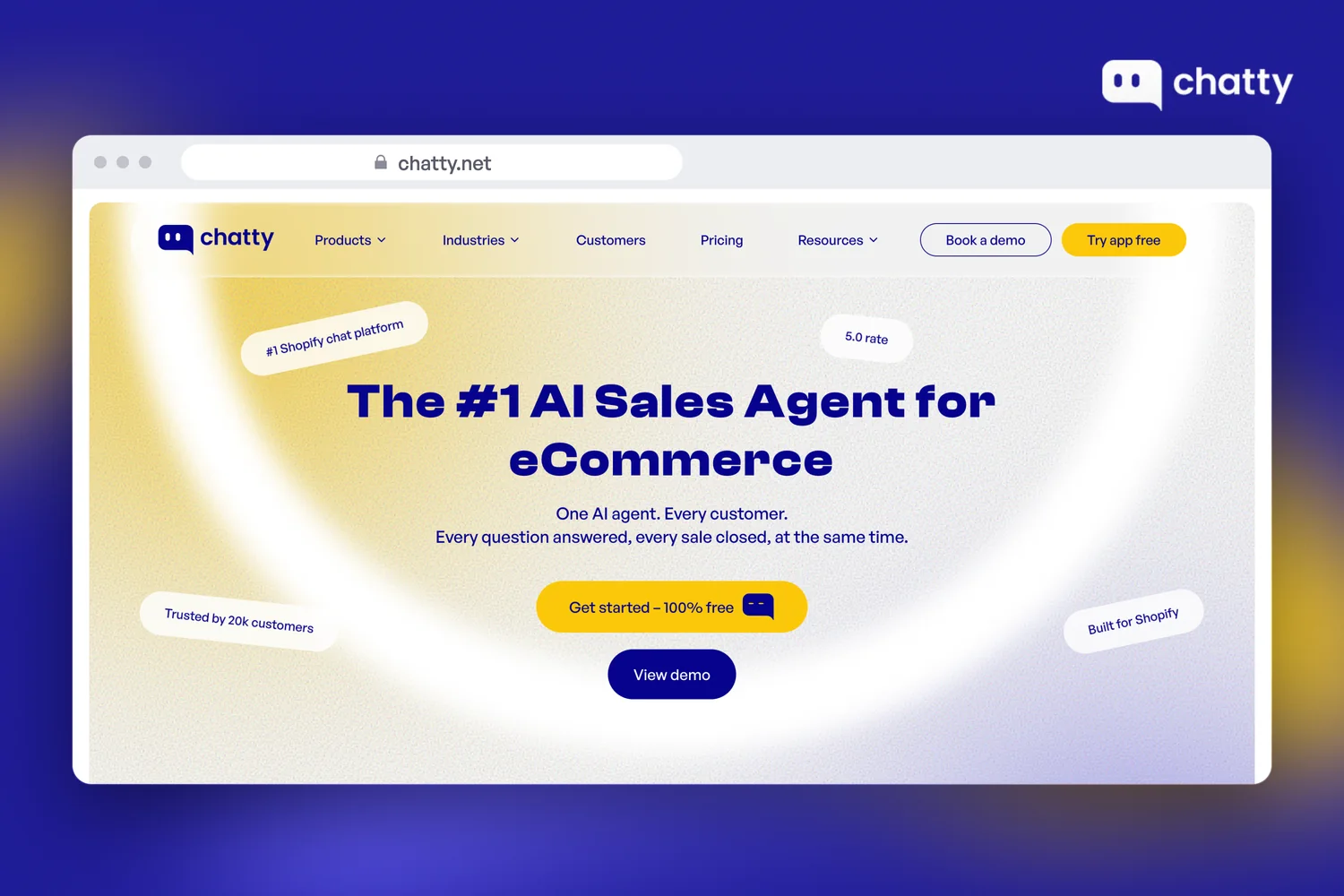
Merchants install Chatty to sell. The AI reads your Shopify catalog, your FAQs and your policies. Chatty carries Shopify's Built for Shopify badge, one of only three here.
It is also the only app on this list that will put a product into the shopper's cart and take one out again. That changes what the conversation does.
Elsewhere you answer "does this run small?". Here you answer it and load the right size while the shopper is still reading.
That is the AI-powered sales job. Chatty works on web, WhatsApp, Messenger, Instagram and email, and offers no SMS channel.
What stood out when we used it:
- It answers from the catalog, not from a script. Ask "does this run small?" and you get a real answer with the size guide behind it. Recommendations came from our actual bestsellers, and the AI stayed inside stock and policy, so we never had to walk back an answer.
- It builds the cart while the shopper reads. It put the right variant in without us asking, which is the difference between a chat that informs and a chat that closes.
- Setup was easy. We were answering shoppers the same afternoon we installed it.
- It kept up on its own. We added products and changed variants across three months and never went back to retrain anything. The FAQ hub was the only thing we touched, and only when a policy changed.
- Merchant sentiment sits near the top of the list. Of the 1,791 reviews we read, 0.9% are one or two stars, and only BestChat scores lower.
Where it falls short:
- The AI conversation counter is what moves the bill, not the plan card. A $1,000 monthly spending limit on AI usage is applied by default, with an email alert when you reach it.
The meter matters more than the tier here. Chatty starts free with 50 AI conversations a month, and the paid plans run $19.99, $68.99 and $199 as that allowance climbs to 1,000.
What Chatty counts is AI conversations, never seats or human replies. So a two-person team pays the same $19.99 whether it handles 500 conversations a month or 5,000. Above the allowance you pay $0.40 per AI conversation.
Requests the AI should not settle still get a queue. Chatty Helpdesk is included on every plan, including Free, with no separate charge.
Turn on Helpdesk ticket mode, and emails to your support address become tickets with a priority and an assignee. An agent can also convert any chat into a ticket on desktop.
Choose Chatty when your shoppers ask before they buy and your catalog varies enough that size, stock and bundling are what decide the sale.
2. Tidio
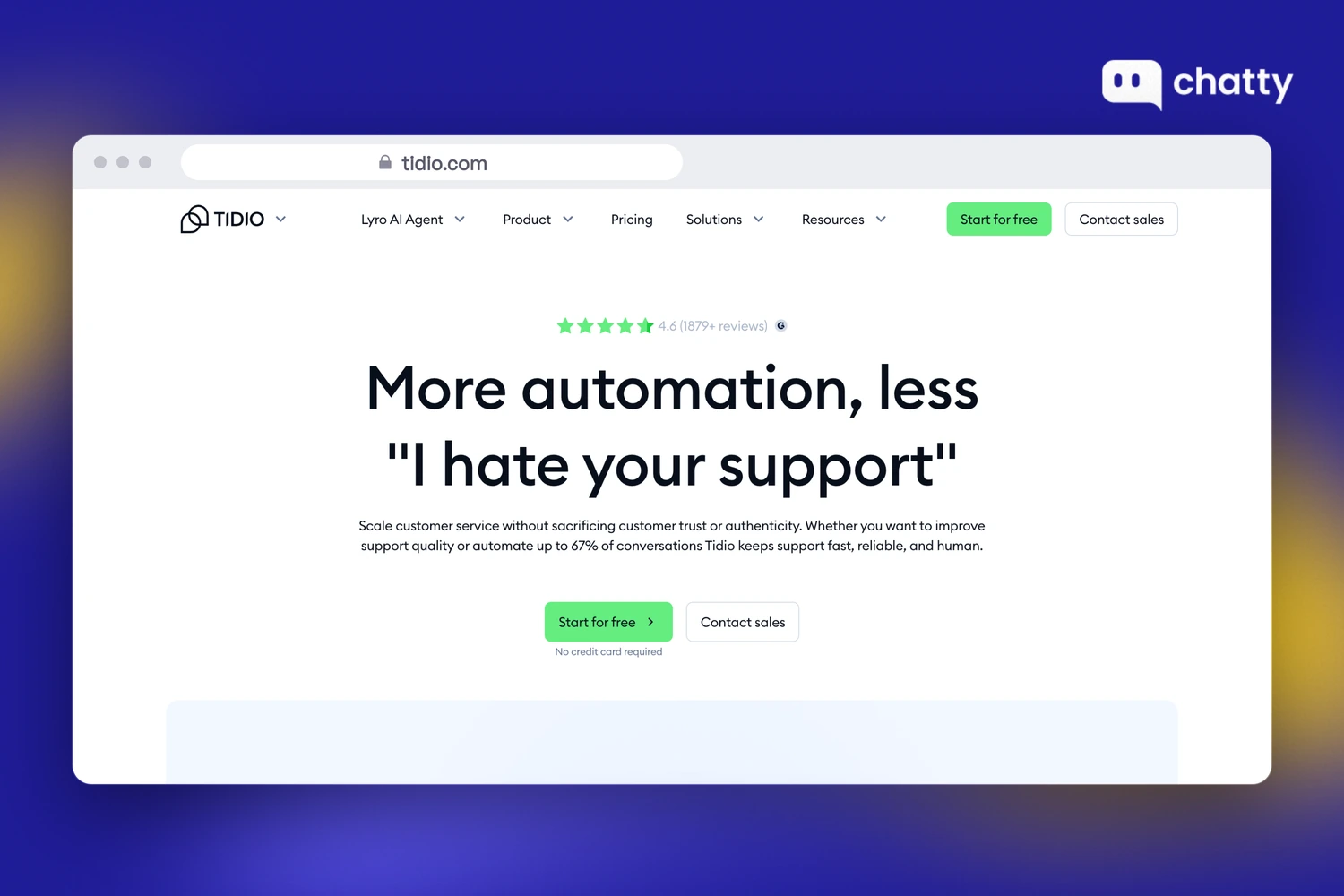
Tidio is the app most merchants land on first. Its Lyro AI is the most openly measured on this list, and Tidio publishes a 67% resolution rate in its own words. What people buy Tidio for is cover during the hours they are asleep.
One furniture merchant described the pattern well: Lyro holds the shopper's attention with product specifications while a human goes and finds the real answer. Live chat, email, Instagram, Messenger and WhatsApp all land in the same inbox.
What stood out when we used it:
- Lyro earns its place on deflection. It handled shipping, returns policy and stock questions without us, which matches the 67% resolution rate Tidio publishes.
- The handover is the part we rated highest. Every time we pushed Lyro past what it knew, it passed the chat to a person cleanly, and we never had to rescue a conversation.
- It holds a shopper's attention. One furniture merchant describes the same pattern in a review. Lyro keeps the shopper talking about specifications while a human goes and finds the real answer.
- Nothing had to be configured first. We were live inside an hour of installing it.
- It is the only app here whose reviews are improving, from a 4.53 average in 2024 to 4.77 across 239 reviews in 2026.
Where it falls short:
- It recommends, then it waits for you. Lyro suggests a product and stops there, so the closing is still your job.
- Three products, three meters, one brand. Live chat, Flows and Lyro behave like three tools sharing a login. You upgrade one and the other two stay where they were. One merchant wrote in July 2025: "paying for flows, then chats, then customer service. I paid for a plan and in 1 day I needed to upgrade again."
- There is no overage, only a hard stop. The inbox closes at the limit and you cannot reply until you upgrade.
Tidio splits the bill in a way nothing else here does. The free tier carries live chat for 50 users, and Customer Service starts at $29 for 100 conversations. The Lyro AI you came for is a separate $39 subscription on top of that.
Past 1,000 conversations or 200 Lyro conversations the listing stops publishing a price altogether. Cancelling or refunding an order from the inbox needs the Growth plan.
Tidio fits a small team that needs cover through the hours it is asleep. You just have to live with three line items on one invoice.
3. Richpanel
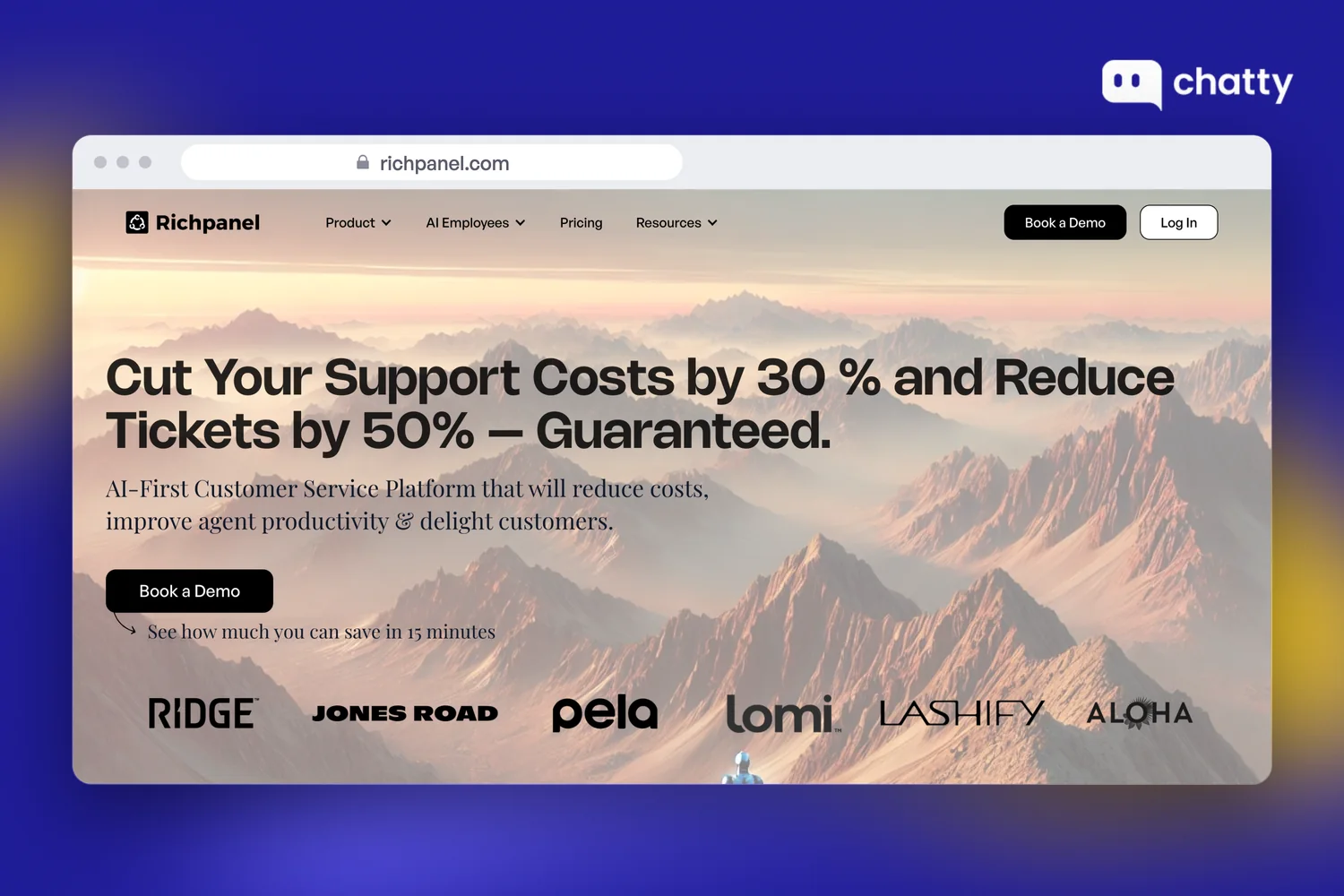
Stores with heavy after-sales work buy Richpanel. Richpanel's AI is published as resolving order status, returns, refunds, cancellations and subscriptions end to end. It runs inside refund limits and approval rules you set yourself.
No other vendor here describes a guardrail like that, and that guardrail is what makes letting an AI touch refunds a reasonable decision. Email, chat and social are covered on every plan, while SMS and the Social Media AI agent stay behind PRO MAX and above.
What stood out when we used it:
- It has the deepest after-sales automation on this list. It closes returns, refunds and cancellations without a person touching them.
- The guardrail is real. It works inside refund limits you set yourself, so the AI never approves something you would not have.
- On order status it was the most self-sufficient tool we used. Richpanel publishes a 50% resolution rate across support and markets it as guaranteed.
- The automation holds. Returns and refunds stopped reaching us and did not creep back the way rule-based setups usually do.
- Onboarding is hand-held, and its reviewers say so. Of 63 substantial positive reviews we read, 11 mention onboarding or migration and every one of them is praise. One describes moving a dozen agents across without disruption.
Where it falls short:
- You are configuring an automation platform, not dropping in a widget. Budget real time for the rule set before you judge the results.
- You never stop being the administrator. Every policy change means going back into the rules, and nobody at Richpanel does that with you.
- Two of its own pages quote AI prices four times apart. The App Store listing says "from $0.20 each", while Richpanel's calculator sells the same AI in blocks with a $200 monthly floor. That makes 250 AI conversations $50 on one page and $200 on the other. One merchant wrote in September 2025: "way more expensive than you initially think it is. You need to pay for the Self-Service add-on."
- One merchant disputes the AI directly, saying it does not answer customer questions the way the marketing implies. With 122 reviews in total at our August read, that is one voice. It is also the only first-hand account of the AI we could find.
Your headcount sets this bill, not your traffic. PRO costs $89 a user and PRO MAX $119, so two people start at $178 before any AI is switched on. There is no free plan behind the 14-day trial.
Richpanel's own pricing page and its listing show different seat prices, so check which page you will be billed through before you buy.
Go with Richpanel when your store is helpdesk-heavy and someone can own the project, with a returns queue large enough to be worth automating.
4. Gorgias
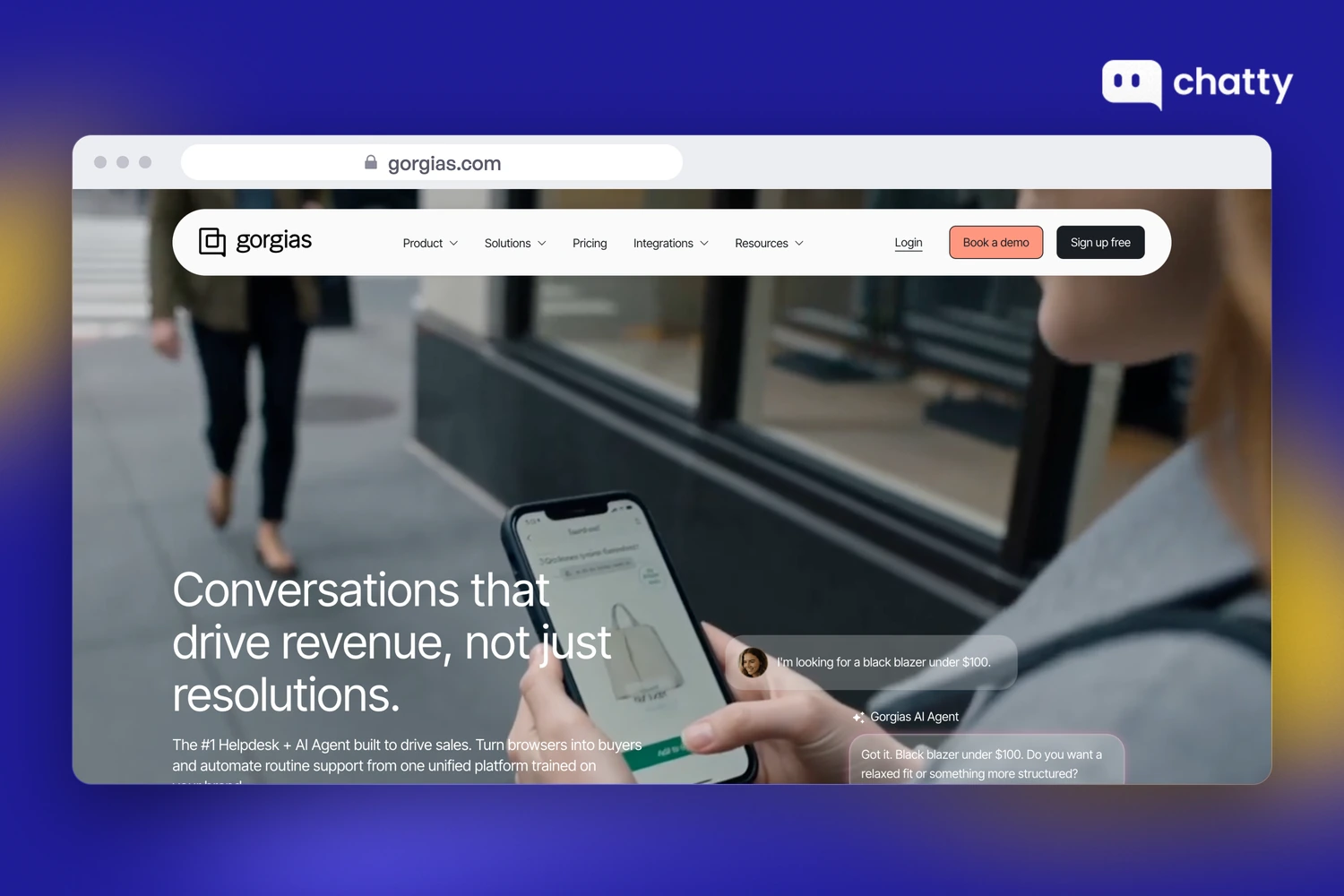
Most merchants do not buy Gorgias for the chat widget. They buy Gorgias to stop answering the same ticket twice. TUSHY has been on the platform for years and described the value as visibility to solve problems at the root.
The reporting underneath is the real product, and that is why Gorgias holds up at stores that have outgrown a shared inbox. Email, chat and social come as standard, while voice and SMS are sold as paid add-ons on top.
What stood out when we used it:
- It buys volume reduction that lasts. The reporting shows which product or policy generates the same ticket over and over, so you fix the cause instead of the ticket. TUSHY, on it for years, describes exactly that.
- It is the most capable support tool here. Gorgias publishes a 60% automation rate, and one merchant this year called the number of resolutions "a little scary".
- Headcount never enters the bill. It meters tickets and never agents, which is why larger teams end up here.
Where it falls short:
- Setup is a project, not an afternoon. Of 312 substantial positive reviews we read, 31 mention an onboarding or migration process, against zero for Chatra. Most of those 31 praise the onboarding team rather than complain, and two describe the work itself.
- It closes conversations rather than opening carts. On the selling side it does far less than the AI sales tools here.
- One automated conversation moves two meters at once, because an AI resolution carries an outcome fee and also counts as a ticket. That fee is $1.00 per resolution on monthly billing, published on gorgias.com and absent from the Shopify listing.
- Ten of its 65 negative reviews describe unexpected charges with amounts attached. Merchants report $400 taken during a seven-day trial, a $780 overcharge and $900 billed after cancellation.
- Sentiment is sliding. Its rating has fallen from a 4.30 average in 2024 to 3.69 across 71 reviews in 2026. And 10.5% of all 617 reviews sit at one or two stars.
Gorgias meters tickets and never agents. The ladder runs $10 for 50 tickets, $60 for 300, $360 for 2,000 and $900 for 5,000, with overage charged above each step.
AI resolutions are billed separately again at a rate the pricing page does not publish. There is no free plan and the trial runs seven days.
Gorgias earns its price once ticket volume has outgrown one person, on a team large enough that per-agent pricing elsewhere would cost you more.
5. LiveChat
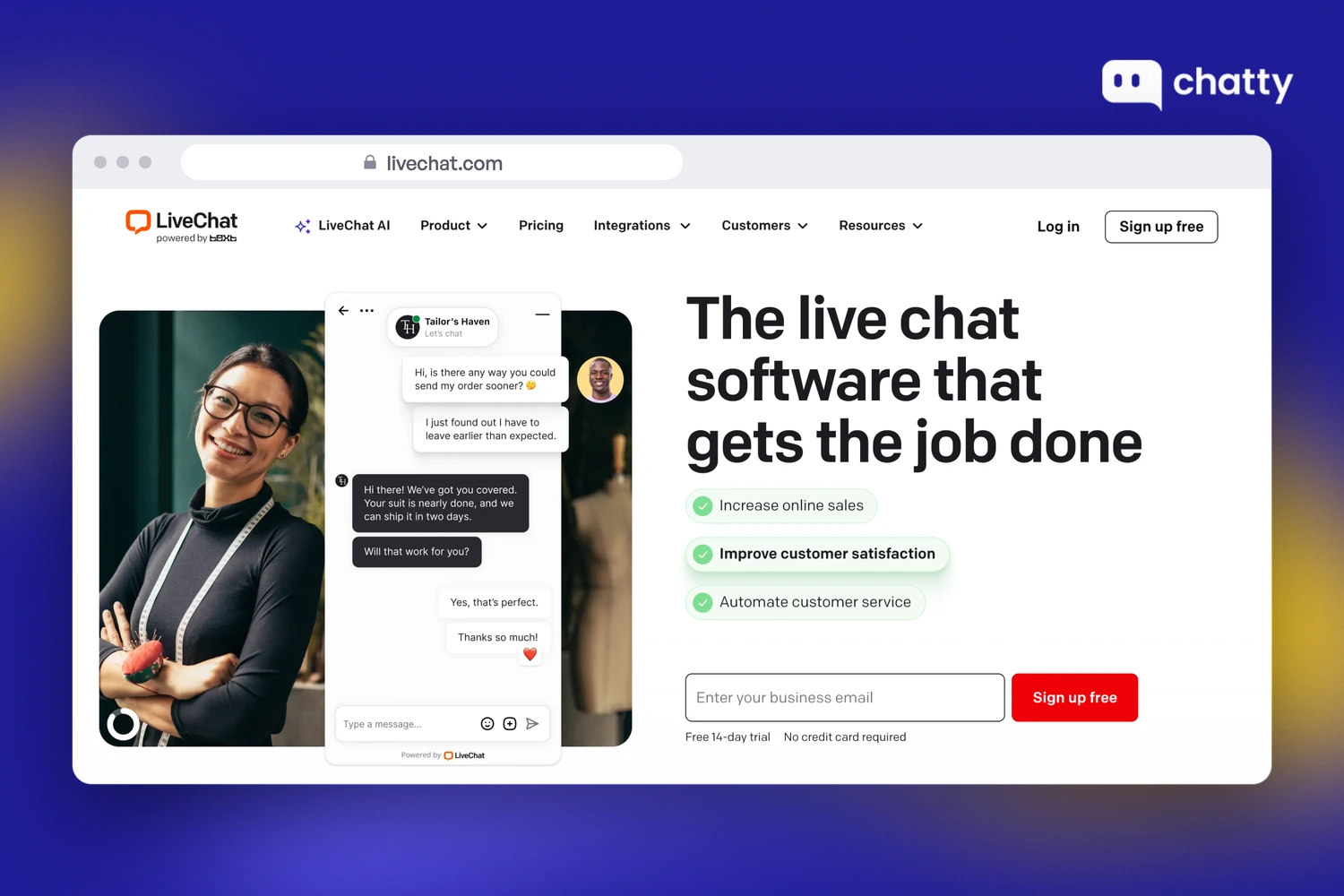
LiveChat is the oldest chat console here. Routing, tagging, canned replies and reporting have all been refined over two decades. Order details and cart contents sit right in the conversation, and the chat widget is the whole product, backed by more than 200 integrations.
Buy LiveChat when the chat itself is the job and you want your agents in software that works smoothly.
What stood out when we used it:
- It is the best-built console of the ten. For a team of humans answering chats all day, nothing here comes close on routing, tagging and reporting. Agents work faster in it, and that is a real result.
- Setup was easy and nothing changed afterwards. Across three months the tool never asked anything of us, which is the point of it.
- The bill never moves. No conversation meter, ticket meter or AI meter exists on either page, so a Black Friday spike costs what a slow Tuesday costs.
Where it falls short:
- Automation is the weaker half. The Shopify listing offers reply suggestions, while livechat.com describes an agent that resolves cases on its own, and we could not reconcile the two. Its published "up to 74%" carries no sample size, no period and no method.
- Its two pages disagree on the price unit. The listing publishes bare monthly figures and never names a unit. We checked that block, and the words "per", "seat", "user" and "agent" appear zero times in it. Its own site prices every tier per person and caps Starter at one user. So two people cost $59 or $118 depending which page you read. One merchant hit this in May 2023: "They don't honor shopify prices either."
- You work alone here. At our August read it had 42 reviews in 104 months, which is 0.4 a month. The next quietest listing on this list still runs at two and a half times that pace.
Two decades of refinement show in how plain this ladder is. Starter costs $25, Team $59 and Business $89 on monthly billing, falling to $19, $49 and $79 if you pay for the year.
There is no free plan behind the 14-day trial. Read those figures alongside the unit problem above, because the listing never names what they are charged per.
Reach for LiveChat when a human-led team wants the strongest console here and a bill that does not move when your traffic does.
6. Chatra
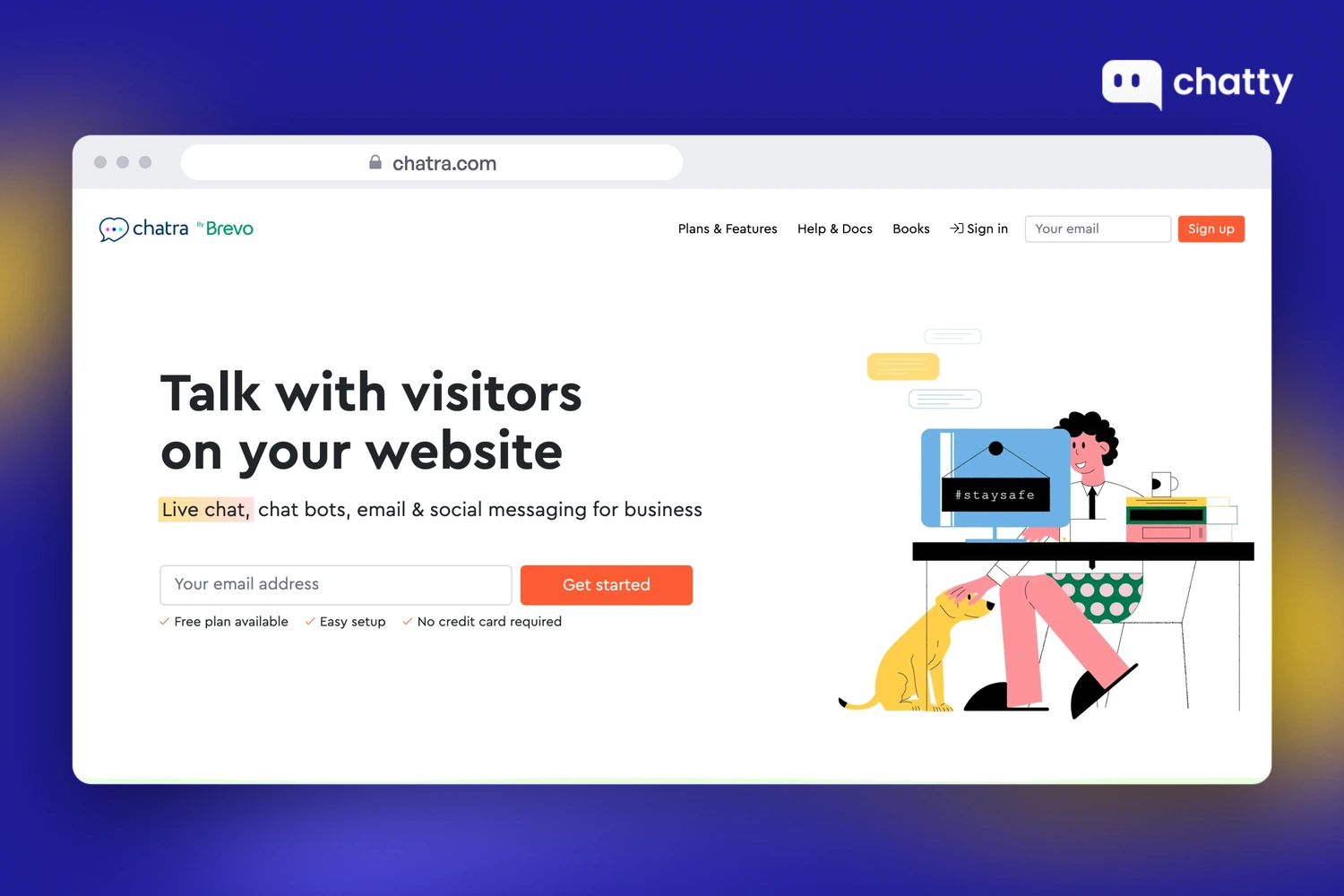
Chatra is for merchants who want to talk to shoppers themselves. Agents watch carts fill in real time and can open a conversation before anyone asks. The whole product assumes a person is there, and Chatra carries the Built for Shopify badge.
The chat widget, email, Messenger and Instagram are covered. WhatsApp, SMS and voice are not. Buy Chatra when the conversation is part of what you sell.
What stood out when we used it:
- There is nothing to configure at all. We read 87 substantial positive reviews and not one mentions setup effort, where the same count for Gorgias is 31.
- It puts a person in front of a shopper at the right moment. Watching carts fill in real time changed how we opened conversations. We could see what someone was stuck on before they asked, and a well-timed message at that point converts.
- The phone app carried the work. We rarely opened a laptop across three months.
- Its listing and its website agree on every figure we could compare. We priced all ten from both sources and found conflicts on four.
Where it falls short:
- Nothing answers when you are away. There is no AI resolution here, so every chat outside your hours is still waiting when you get back. Chatra publishes no autonomous-resolution claim and no resolution rate, and its own documentation describes its bot as a form with configurable fields.
- Cost grows with the team rather than with volume. Merchants have been caught by that twice over five years, once in 2021 and again in 2026.
- One 2026 review reports the widget filling with bot traffic.
Chatra bills by the head. Essential costs $31 an agent and Pro $41, so two agents come to $62. The bill grows with your team rather than with your traffic.
The free plan allows one agent and five chats a month, which will not carry a real store. No conversation meter, ticket meter or AI meter exists anywhere in the product.
Chatra suits a one to three person store that sells on conversation, where the human being answering is part of what customers are buying.
7. Willdesk
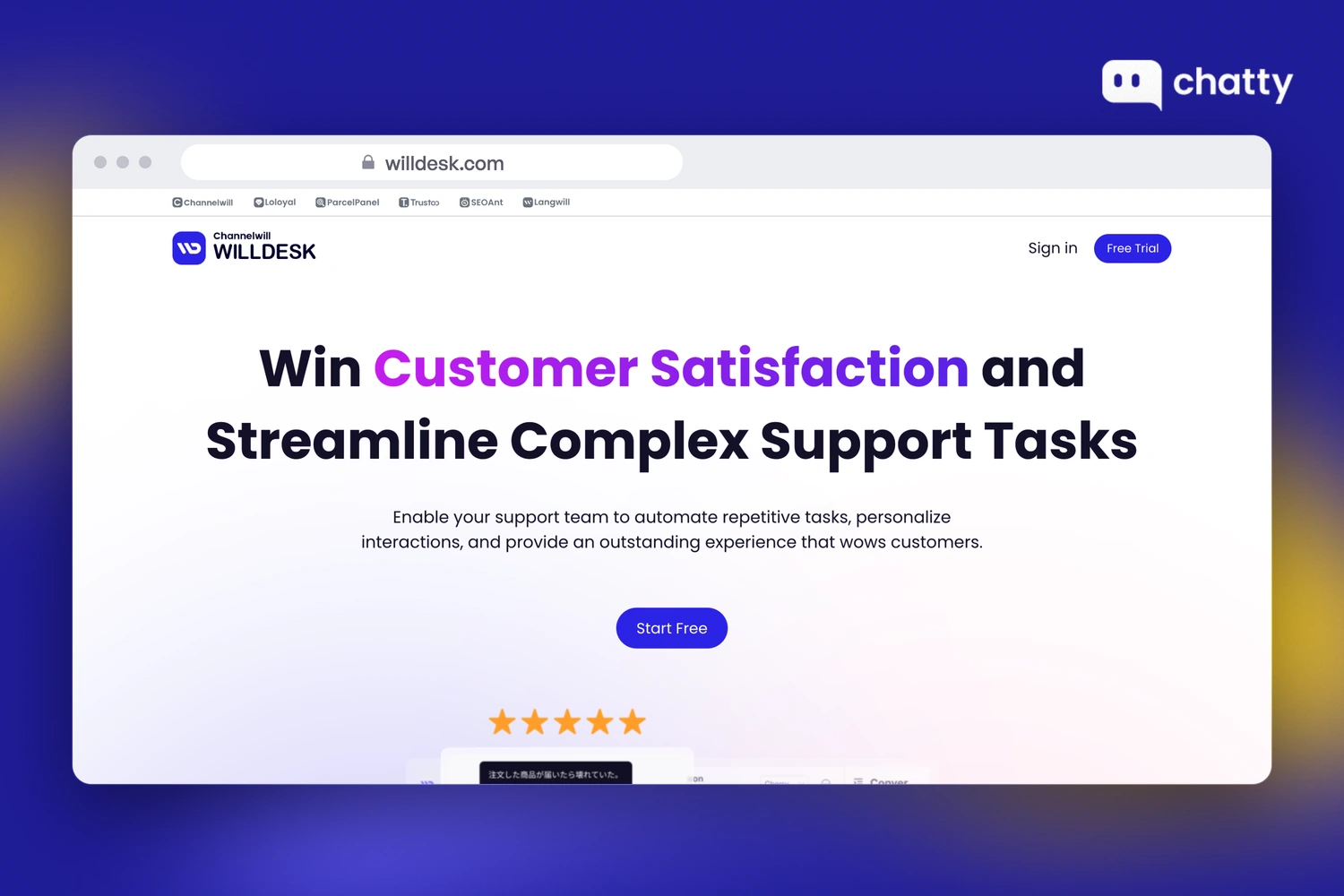
Stores with more helpers than budget install Willdesk. One decision explains why. Agent seats are unlimited and free on every tier, including the free one, and nobody else here does that.
Six part-time agents handling 400 conversations a month costs about $53, where Chatra would be $186 and Richpanel $534. Email, live chat, Instagram, Messenger and WhatsApp all run through the one inbox.
What stood out when we used it:
- Free seats change how a small team works. We stopped sharing one login and could see who was answering what from day one, and the inbox stayed tidy as the team grew.
- Order tracking pulls its weight. It answered "where is my parcel" without us, and that is the question we stopped seeing in the inbox.
- Chat, email and social land in one inbox without gaps, and setup was easy.
Where it falls short:
- The AI is the part we would introduce slowly. A June 2025 review describes "a random automated reply to one of our customers, even though we had disabled the chatbot and any AI agent."
- Willdesk claims returns, cancellations and address updates through the AI. We could not find vendor documentation showing whether the AI does those in Shopify or flags a person.
- Two merchants 14 months apart quoted the listing's own channel promise back at it and said the channel did not work as described. We would switch features on one at a time and check each one lands.
- Three meters run at once. Conversations cost $12 per 100 on Basic or $10 per 100 on Pro, AI conversations are $0.20 each, and tracked orders are $4 per 100.
Seats are the thing Willdesk gives away. Willdesk meters conversations instead, starting free at 20 a month and moving to $16.90 for 100 and $89.90 for 1,000. Agent seats stay unlimited and free on every tier, including the free one.
Buy through the Shopify App Store rather than direct, because the vendor's own site prices that same 1,000-conversation tier at $149.90.
Take Willdesk when four or more people share that inbox on moderate volume and per-seat pricing everywhere else is the thing hurting you.
8. Re:amaze
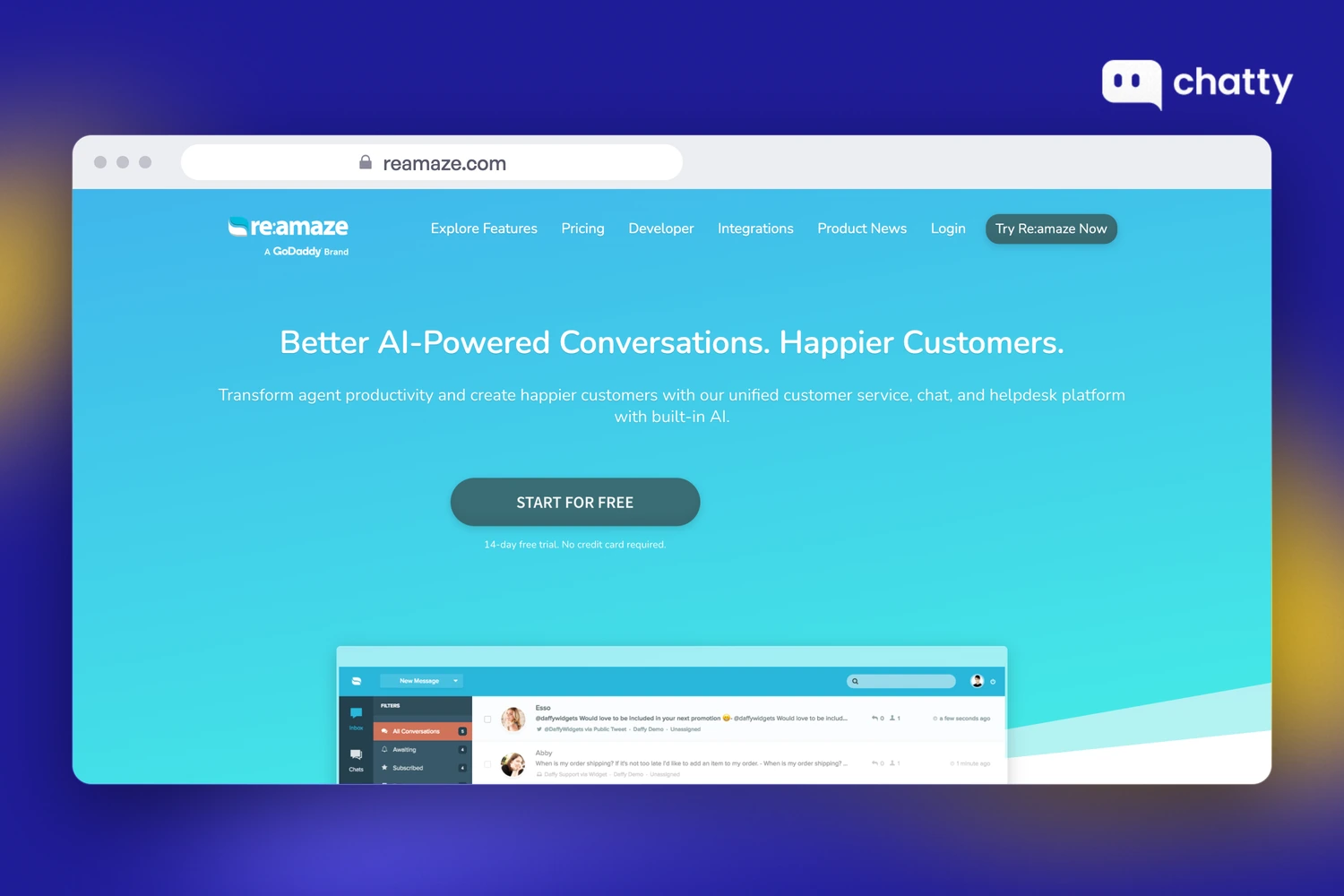
Re:amaze is a full help desk. Re:amaze manages, modifies and creates Shopify orders from the support view. It also carries the best-value plan on this list, which most roundups miss.
Starter is $59 flat with unlimited team members and 500 responded conversations, plus extra packs of 100 for $15. So a six-person team on low volume pays $59 here and $186 at Chatra. Email, live chat, social, SMS and calls are all supported, though SMS and VOIP need Pro or above.
What stood out when we used it:
- Order handling is its strongest feature. Agents manage, modify and create Shopify orders without leaving the conversation, which removes the tab-switching that slows most support teams down.
- Setup is easy and it stops needing attention. Once we knew our way around, it did the helpdesk job properly and we forgot it was there.
Where it falls short:
- The dashboard takes a week to learn. One of its own reviewers puts it the same way, calling the dashboard not laid out intuitively for a quick glance.
- The AI is the part we would leave switched off. At $0.85 per resolution only Gorgias charges more, and Re:amaze labels its own agent "(Beta)" on its features page.
- Leaving is the clearest theme in its negative reviews. Four merchants describe the same shape. One uninstalled the app and it still had site access. One kept receiving marketing email after deletion, with no unsubscribe link. One cancelled before the rebill date and was charged anyway. One found a Shopify deletion was not accepted as cancellation.
- These are not first-week complaints. The unhappy voices use phrases like "about 5 years" and "about 6 years", and 10.5% of its reviews sit at one or two stars.
Re:amaze sells two shapes at once. Basic, Pro and Plus cost $29, $49 and $69 per team member. The flat $59 Starter plan carries unlimited members and 500 responded conversations.
Extra AI resolutions then cost $0.85 each. That is how Re:amaze ends up among the cheapest here with the AI off and among the dearest with it on. There is no free plan and the trial runs 14 days.
Re:amaze works best for a larger team on low, steady volume that takes the flat Starter plan and leaves the AI switched off.
9. Chatway
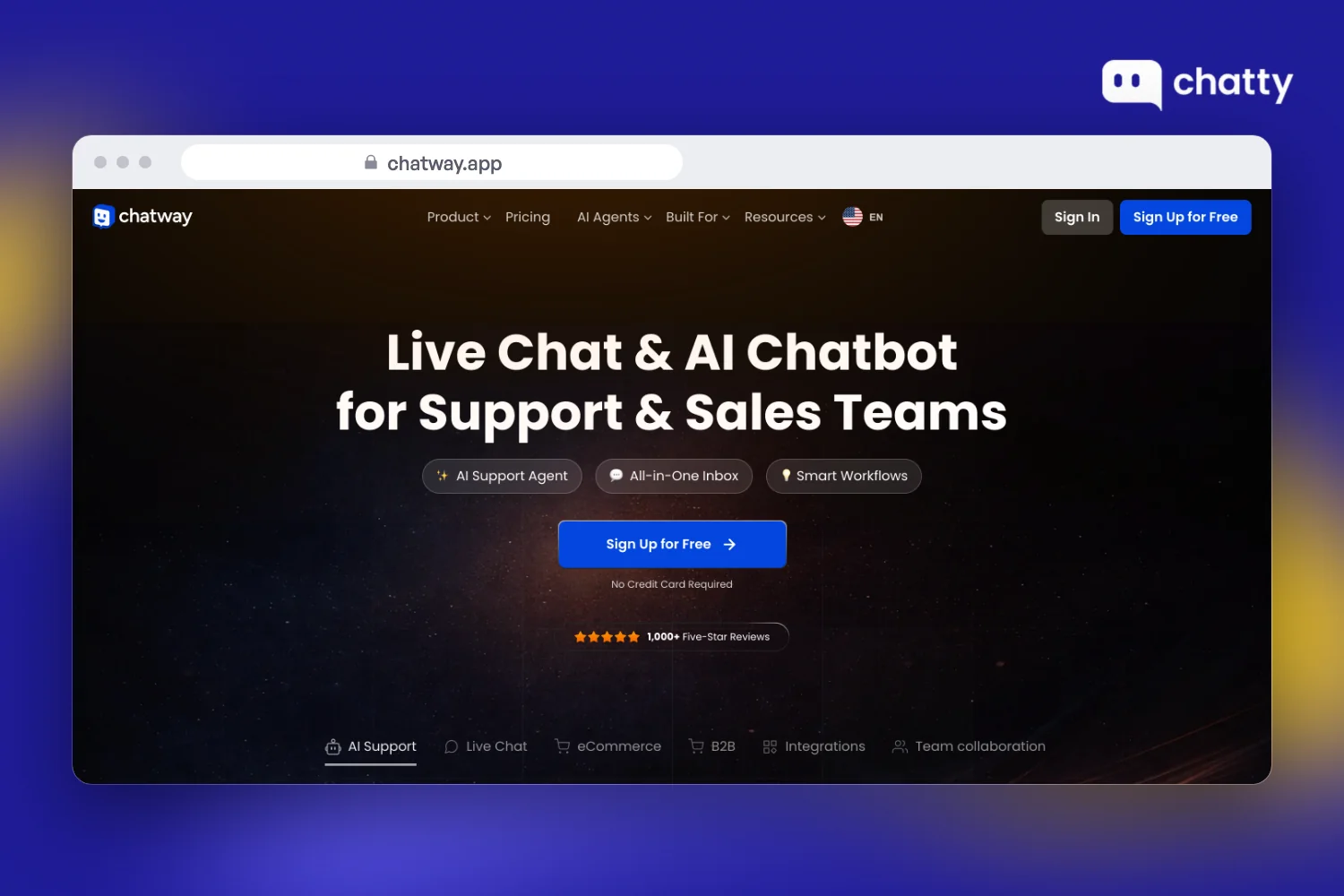
Chatway is the fastest app here to get live. Its free plan covers one seat and 50 conversations a month with 30 days of history.
Email, WhatsApp, Messenger and Instagram start on the paid Business plan. Merchants pick Chatway when they want chat working today.
What stood out when we used it:
- Setup took minutes, not an afternoon. Install it, drop in the widget, and that is the whole job.
- The inbox is unusually complete for the money. Cart, order and coupon data sit side by side. An agent sees what someone is buying and what discount they already hold, without opening another tab.
- The AI knows its limits. It takes the repeat questions and hands over when it is out of depth, and it did not overreach once while we watched.
- Only 1.5% of the 261 reviews we read in August sit at one or two stars.
Where it falls short:
- It is a competent support tool rather than a selling one. Nothing here opens a cart for the shopper.
- Every plan now caps conversations. Since our August read, Chatway has replaced its uncapped plans. Business covers 200 conversations a month and Plus 1,000, and nothing larger is sold through Shopify.
- The AI sits outside the plan entirely at $0.50 per resolved conversation with no included allowance, and that rate appears only on Chatway's own site.
- Two of its four negative reviews are public disputes with the company rather than complaints about the product, and they are worth reading yourself.
Chatway sells seats in bundles, each with a conversation cap. On its Shopify listing, Business costs $39 a month for two seats and 200 conversations. Plus costs $199 for ten seats and 1,000 conversations, and both come with a 14-day trial.
Chatway's own site adds extra seats at $19 a month and a custom Enterprise plan above that.
Pick Chatway when a small team wants chat running this afternoon and its volume stays under 1,000 conversations a month.
10. BestChat
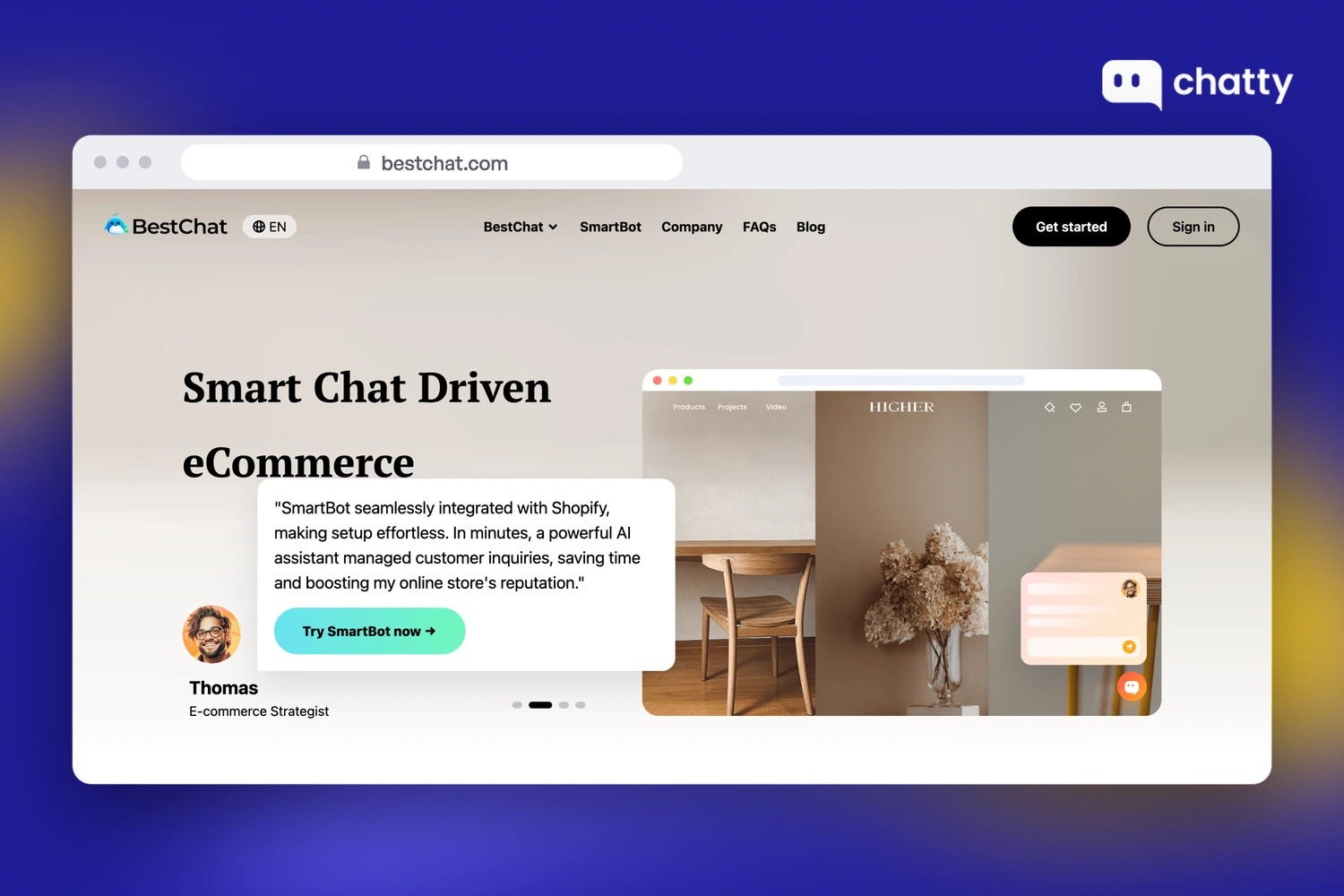
BestChat is the cheapest way to put AI in front of shoppers. On the one number its listing lets you calculate, BestChat wins by a wide margin. At the $60 tier you pay $0.02 per AI chat, where the next cheapest effective rate we worked out is $0.138.
The SmartBot learns from your products, orders, terms and FAQs, human chats are never metered, and BestChat carries the Built for Shopify badge. Its two pages disagree on channels, though: the site claims Facebook, Instagram, WhatsApp, Line and email, while the listing names only Instagram.
What stood out when we used it:
- It is quick to set up and undemanding afterwards. The bot learns from your products, orders, terms and FAQs, and it took the routine questions without help.
- For deflection at this price nothing else here is close. It stayed cheap and it stayed quiet across three months.
- It recommends and upsells inside the conversation rather than only answering what it is asked.
- Of the 134 reviews we read, exactly one sits at one or two stars, the lowest rate of all ten apps.
Where it falls short:
- It will not finish an after-sales case. No BestChat sentence claims end-to-end resolution, and the handover to a person is the design.
- The bot is confident. Its single negative review describes it promising an immediate reshipment "(even committed to delivery time!) when we were offline without any consent from us."
- You meet the ceiling rather than the bill. Nothing above 3,000 AI chats a month or six agent seats is sold through Shopify billing, so growing past that means renegotiating outside Shopify.
- No overage rate is published on either page, so what happens when the allowance runs out is unclear.
Two ceilings move together on every BestChat plan, the AI meter and the seat count. Free covers 80 AI chats on one seat, and $10 buys 300 chats on one seat. Then $30 buys 1,000 on three and $60 buys 3,000 on six.
No annual option is published anywhere. BestChat's own site carries a $450 Enterprise plan for unlimited AI chats that the listing never mentions.
BestChat makes sense for a small store that wants cheap AI deflection and is content to take the handover itself.
How to choose a Shopify live chat app on cost
The ten apps meter five different things, so the cheapest name changes as your volume, your headcount and your automation change. The only way to see that is to price one store on all ten.
We gave that store two support people and either 500, 2,000 or 5,000 conversations a month. Every figure below comes from the app's own Shopify App Store listing, re-checked on 12 October 2026. Where a figure carries a dagger, part of it is missing from the listing and comes from the vendor's own site instead.
What it costs with the AI switched off
In this first table the two humans answer everything and no AI is bought. This is the floor, the least you can pay to keep the inbox open at each volume.
| App | Unit | 500/month | 2,000/month | 5,000/month |
| Chatty | AI conversation | $19.99 | $19.99 | $19.99 |
| BestChat | AI chat | $30 | $30 | $30 |
| Re:amaze | Staff user | $58 | $58 | $58 |
| LiveChat | Not stated on the listing | $59† | $59† | $59† |
| Tidio | Billable conversation | $59 | Not published† | Not published |
| Chatra | Agent | $62 | $62 | $62 |
| Willdesk | Conversation | $64.90 | $189.90 | $489.90 |
| Gorgias | Ticket | $140 | $360 | $900 |
| Richpanel | User seat | $178† | $178† | $178† |
| Chatway | Bundle of seats, with a conversation cap | $199 | No plan published | No plan published |
At 5,000 conversations a month the same work costs $19.99 on one app and $900 on another. Nothing in that gap is a feature difference.
Apps that charge per seat stay flat as the volume climbs, which is why Richpanel looks expensive at 500 conversations and reasonable at 5,000. Apps that meter tickets or conversations do the reverse, starting cheap and then climbing past everyone.
What it costs once AI answers half the conversations
Now the same store lets its AI resolve half of each volume: 250 conversations at 500, 1,000 at 2,000 and 2,500 at 5,000. The two humans take the rest.
Half is our own assumption rather than any vendor's claim. We picked it because it is a round number that flatters nobody.
| App | 500/month | 2,000/month | 5,000/month |
| BestChat | $30 | $30, at the cap | $60 |
| LiveChat | $59†, no AI meter | $59† | $59† |
| Chatra | $62, no AI meter | $62 | $62 |
| Chatty | $68.99 | $199 | $799 |
| Willdesk | $114.90 | $389.90 | $989.90 |
| Richpanel | $228† | $378† | $678† |
| Re:amaze | $262† | $899.50† | $2,174.50† |
| Chatway | $324† | No plan published | No plan published |
| Gorgias | $390† | $1,360† | $3,400† |
| Tidio | $59 plus Lyro, not published† | Not published† | Not published |
If your AI handles more or less than half, every AI-metered row moves with it while the seat-priced rows stay exactly where they are.
A plan fee is a floor rather than a ceiling on six of the ten. Chatty charges $0.40 per AI conversation above the allowance, Willdesk charges $0.20, Chatway charges $0.50 per resolved conversation and Re:amaze charges $0.85 per resolution. Gorgias and Richpanel meter AI on rates of their own.
Tidio is the exception, because Tidio sells its Lyro AI as a flat module and then hard-stops instead of charging overage. Hit the conversation limit on Tidio and you cannot reply to anyone until you upgrade.
Two apps stop having a published price before 5,000. Chatway's largest Shopify plan, Plus at $199, covers 1,000 conversations a month.
Above that, Chatway sells a custom Enterprise plan on its own site.
Tidio's listing publishes nothing above 1,000 billable conversations or 200 Lyro conversations, and its calculator sends you to sales past 2,000. BestChat still has a price at 5,000, $60, but it is close to a ceiling.
Nothing above 3,000 AI chats or six seats is sold through Shopify billing at all. Its $450 Enterprise tier appears only on its own site.
What one AI conversation costs
Plan fees hide this number. Divide each plan by the AI conversations it includes and the apps separate immediately.
| App and plan | Included AI, per month | Effective rate | Rate once the allowance runs out |
| BestChat Growth, $60 | 3,000 AI chats | $0.02 | Not published |
| Chatty Pro, $68.99 | 500 | $0.138 | $0.40 |
| Tidio Lyro, $39 | 200 | $0.195 | Upgrade, no rate published |
| Chatty Plus, $199 | 1,000 | $0.199 | $0.40 |
| Richpanel | None included | n/a | $0.20, or $200 blocks on its own site |
| Willdesk | None included | n/a | $0.20 |
| Chatway | None included | n/a | $0.50 per resolved conversation |
| Re:amaze Basic | 5 per user | n/a | $0.85 per resolution |
| Gorgias | None included | n/a | $1.00 per resolution, and it burns a ticket too |
BestChat is an order of magnitude cheaper per AI chat than anything else here. That rate is the one number its listing lets you calculate.
Read it against the caps, because no plan sold through Shopify goes past 3,000 AI chats or six seats. And no BestChat sentence claims end-to-end resolution.
Cheap AI that hands the conversation back to you is a different purchase from AI that finishes the job.
What a seat costs
Willdesk and Gorgias never charge for an agent, and Chatty's Basic plan states five members and Plus unlimited. Re:amaze sells one flat $59 Starter with unlimited team members and 500 responded conversations, plus extra packs of 100 for $15.
Everyone else bills by the head. That is why Richpanel costs $178 for two people at any volume while Gorgias runs anywhere from $140 to $900 for the same two.
The rule that falls out of it is short. If your volume is high and your team is small, avoid ticket meters first and per-seat pricing last. If your team is large and your volume is modest, invert that.
Where you buy it changes the price
Willdesk is cheaper through Shopify. The 1,000-conversation tier costs $89.90 on the App Store listing and $149.90 on the vendor's own site, for exactly the same allowance.
Richpanel's AI rate depends on which page you read. The listing says AI conversations run "from $0.20 each".
Richpanel's own site sells that same AI in blocks with a $200 monthly floor. So 250 AI conversations costs $50 on one page and $200 on the other.
Its seat price also differs between the two pages, so confirm the figure on the page you will be billed through.
How many extra orders make the app free
Every roundup compares these prices against each other. None compares a price against what it has to earn back, which is the question that actually decides whether you can afford one.
Take your average order value, multiply it by your gross margin, and you have the profit one extra order puts in your account. Divide the app's monthly bill by that figure.
Orders to break even = monthly cost / (average order value x gross margin)
The table below runs that sum at a $60 average order value and a 40% margin, so $24 of gross profit per order. It uses the two-person team at 2,000 conversations a month with AI handling half.
| App | Monthly cost | Extra orders a month to break even | Or agent hours it has to save |
| BestChat | $30 | 2 | 2 |
| LiveChat | $59 | 3 | 3 |
| Chatra | $62 | 3 | 3 |
| Chatty | $199 | 9 | 8 |
| Richpanel | $378 | 16 | 16 |
| Willdesk | $389.90 | 17 | 16 |
| Re:amaze | $899.50 | 38 | 36 |
| Gorgias | $1,360 | 57 | 55 |
The last column runs the same arithmetic against a $25 fully loaded support hour. Most people buy a help desk to remove work rather than to add orders.
Use whichever column matches your reason for buying. Tidio and Chatway are absent because neither publishes a price at this volume through Shopify.
The test is not which app comes out cheapest. It is whether the number is plausible for your store. Nine extra orders a month is a low bar for a store already handling 2,000 conversations.
Fifty-seven is a different proposition, and it clears only if the automation removes headcount rather than moving tickets into a queue. Run both columns with your own two numbers before you shortlist anything.
How to choose the right live chat app for your store
Cost narrows the list. What your shoppers actually ask decides it, and that splits these ten apps more sharply than any price does.
Nine of these apps close tickets, one closes carts
Richpanel calls its product "AI agents that sell". Gorgias calls its AI "an autonomous assistant for support and sales". LiveChat says "convert chats into sales".
The word sits on every listing, so the word decides nothing. What decides it is the action each vendor publishes.
| App | The cart, inside the chat | Recommendations from your catalog |
| Chatty | Adds items and removes them | Yes, plus size guides and stock status |
| Tidio | Preview only | Yes |
| LiveChat | Visible to the agent | Yes |
| Chatra | Visible to the agent | Cross-sell claimed, not catalog-driven |
| Chatway | Cart data in the inbox | In the feature list, not described in prose |
| BestChat | Not published | Yes, with upsell |
| Richpanel, Gorgias, Willdesk, Re:amaze | Not published | Yes, in each vendor's feature list |
Five apps let you watch the cart. One is published as changing it. If a shopper asks which of two jackets runs truer to size, every app here can answer.
Only one is documented as putting the right jacket into the cart while the shopper is still reading.
The trade cuts both ways. Pre-sale questions are answered from a product catalog, so the tools separate on recommendations, live chat triggers and whether they boost conversions. "Where is my parcel" needs live order state and a policy decision instead, and the four helpdesk-first apps publish far more of that.
Chatty does turn support emails into tickets, but it does not publish the order actions those four are built around. Its Helpdesk also does not document SLA policies, macros or automation rules.
Your floor either way is Shopify's own inbox and order data, with canned responses and social media chatbots worth weighing beside the AI. Pick the side your inbox actually lives on.
Which app fits which store
Every roundup ends with "it depends on your needs". Here is what it depends on, with the numbers attached. Each row is the app we would pick for that store, read off the cost tables above and each vendor's own published claims.
Where two apps do the same job, the cheaper one wins the row. Where they do not, capability decides it and the price is stated anyway.
| Your store | Pick | Why this one | Second choice |
| Shoppers ask before they buy: sizing, fit, bundles | Chatty | The only app here published as adding and removing cart items. Size guides, stock status and bestsellers feed the same conversation that builds the cart | Tidio for catalog recommendations, or BestChat for recommendations and upsell at a lower entry price |
| Solo founder, nothing to spend yet | Chatty or BestChat, free | The two free tiers that never meter human chats. Chatty adds 50 AI conversations a month, BestChat 80 AI chats on one seat | Chatway free: 50 conversations on one seat |
| Two people, and the chat is a cost you want to hold down | Chatty, $19.99 | Human conversations are not metered, so 500 or 5,000 costs the same | BestChat, $30, also meters AI only |
| 5,000 conversations a month with AI doing half | Richpanel, $678 | Of the apps that resolve end to end, a flat two-seat base plus $0.20 per AI conversation is the cheapest at that scale | Chatty, $799 |
| Six or more agents, moderate volume | Willdesk, around $53 | Agent seats are unlimited and free on every tier, including the free one | Re:amaze Starter, $59 flat, unlimited members |
| Inbox is mostly returns, refunds and order changes | Richpanel | Widest published set of end-to-end actions, run inside refund limits and approval rules you set | Gorgias, if your volume is steady enough to price |
| Volume spikes hard at BFCM | Chatra or LiveChat | Neither publishes a conversation, ticket or AI meter, so a spike costs nothing extra | Re:amaze per-seat, which is flat too once the AI is off |
Why a star rating will not settle it
Shopify weights recent reviews more heavily than old ones, so the rating on a listing is not the average of the reviews behind it. We read 4,979 reviews across these ten apps and calculated both numbers.
- Gorgias: Shopify shows 4.2, the mean of all 617 reviews is 4.52, and its 2026 reviews average 3.69 across 71 of them. The gap is the decline.
- Tidio: Shopify shows 4.8, above its 4.70 lifetime mean, because 2026 is running at 4.77 on 239 reviews. Tidio is the only app here moving up.
- Chatra shows 4.5 against a 4.83 mean and Re:amaze 4.3 against 4.57. Both point down, but their 2026 samples of 12 and 5 are too small to call a trend.
- Chatty, Chatway and BestChat all sit within 0.05 of their lifetime means, so their recent reviews match their historical ones.
Comparing 4.3 against 4.6 across two listings therefore compares differently weighted numbers, on sample sizes running from 49 reviews to 1,877. Want to compare AI help desk software on how well the AI answers? No published number substitutes for trialling two apps on your own inbox for a week.
How we evaluated these apps
We publish this list as the team behind one of the apps on it, so here is the method in full.
Every price came from each app's own Shopify App Store listing, read on 12 August 2026 and re-checked on 12 October 2026.
On 12 October we also refreshed the ratings and review counts in the comparison table. Every other rating and review count comes from our 14 August 2026 read.
On 14 August 2026 we also downloaded and read 4,979 App Store reviews across the ten apps, against the 4,994 their listings publish between them. We took every review their listings served, not a sample.
We then checked our star distribution against the one Shopify publishes on each listing, and the two match. Every review figure and quotation in this article comes from that corpus.
Where a figure is not in the listing, we took it from that vendor's own pricing, product or help pages on the same date. We marked it with a dagger. Where a cell quotes a vendor, the words are theirs.
Four apps publish conflicting prices on their own listing and their own site, and we recorded both rather than picking one.
Two limits worth stating. We did not run timed trials under identical load, so nothing here is a benchmark. Where we describe how an app behaves, that is our hands-on read plus what its own merchants report.
We have no measurement to offer on multi-channel performance for any app here. So we make no claim about how these tools handle WhatsApp, Instagram or Messenger. Resolution rates, where vendors publish them, are each defined by that vendor and are not comparable across tools.
Final verdict
There is no single best live chat for Shopify, but there are two clear questions and they answer in order. First, is your chat there to sell or to clear tickets?
If shoppers arrive with questions before they buy, weigh what the AI is trained on and whether it can touch the cart. Chatty is the only one here published as doing both.
If they arrive after the order, Richpanel and Gorgias publish the deepest set of end-to-end actions.
Only then does the billing unit decide.
Pick per-seat if your team is large and your volume steady. Pick per-ticket or per-conversation if volume is low and predictable. Pick per-AI-conversation if you intend to automate.
Run the two that survive on your own inbox for a week before you commit. If your goal is to increase sales rather than close tickets faster, weigh what the AI is trained on above everything in the feature list.
FAQs
On the listings we re-checked on 12 October 2026, Chatty at $19.99 a month is the cheapest way to run a two-seat inbox. It meters AI conversations rather than seats, and it does not meter human conversations at all.
BestChat is $30 and Re:amaze is $58 for two staff users. That ranking changes once AI handles a large share of your volume, because the AI-metered apps move with it and the seat-priced ones do not.
Both, depending on the app, and that is the main reason their listed prices look closer than they are. Richpanel, Chatra, Re:amaze and LiveChat charge per person. Gorgias meters tickets.
Tidio and Willdesk meter conversations. Chatty and BestChat meter AI conversations. Chatway sells bundles of seats, each with a monthly conversation cap.
Always read a price together with its unit.
It depends on what the free plan caps.
Chatty allows 50 AI conversations with human conversations unmetered, and BestChat allows 80 AI chats on one seat. Chatway now caps its free plan at 50 conversations a month on one seat. Willdesk caps at 20 conversations a month and Chatra at 5 chats a month, which a store with traffic will exhaust in days.
Gorgias, Richpanel, LiveChat and Re:amaze publish no free plan at all, only trials of 7 to 14 days.
Most now claim it. Chatty, Tidio, Richpanel, Gorgias, Willdesk and Chatway each publish an autonomous-resolution claim on their own pages. Chatra publishes none, and BestChat describes assist plus handoff.
Every vendor defines resolution its own way, so a resolution rate from one tool tells you nothing about what another would do on your inbox. Pair the AI with proactive chat only after you have seen it answer your own questions.
It depends on what your chat is for. If shoppers ask questions before they buy, pick an app whose AI is trained on your catalog and can act on the cart. Chatty is the only app on this list published as adding items to the cart and removing them.
If most chats are about orders after the sale, Richpanel and Gorgias publish the deepest set of order actions. Then pick the billing unit that grows slowest for your store. Per seat suits a large team with steady volume, and per conversation or ticket suits a small team.
Yes. On 12 October 2026, five apps on this list had a free plan.
Chatty gives 50 AI conversations a month and never meters human chats. BestChat gives 80 AI chats on one seat, Chatway 50 conversations on one seat, Willdesk 20 conversations with unlimited agents, and Chatra 5 conversations.
Shopify's own Inbox app is also free, though it is not one of the ten apps we priced here.
Install the app from the Shopify App Store, then switch on its chat widget in your theme editor under App embeds. None of the ten apps here needs code for the basic widget.
Before you go live, set your business hours and an away message, so shoppers who write after hours know when to expect a reply.